
Not sure where to start with drawing faces? Follow this step-by-step path to learn how to draw realistic faces from the ground up. You’ll learn how to build accurate proportions, place facial features, draw and shade individual facial features in detail, and see how it all comes together on one face shading demonstration.
Step 1: Learn to Construct the Head and Place Features
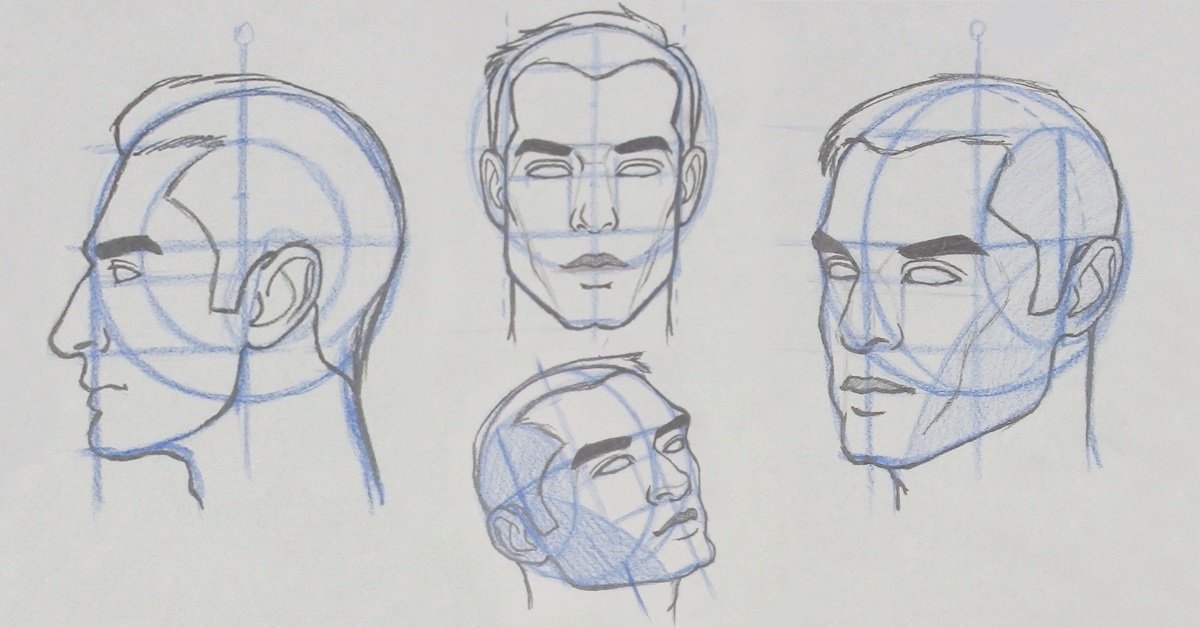
Build a solid foundation for your drawings by learning how to construct the head and place facial features in the right place with accurate proportions using the Loomis method. This step-by-step method creates a strong foundation before adding fine details and shading. Choose the angle you want to master first:

Part 1: Front View
Learn to draw a front-facing head with accurate proportions and feature placement. The best starting point for spotting and fixing common mistakes.

Part 2: Side View
Translate what you learned from the front view to draw a head from the profile view.

Part 3: Three Quarter View
Combine everything you’ve learned thus far to draw the face at a 3/4 angle – the most common view in portrait drawing.

Part 4: Three Quarter View Looking Up
New! The most challenging angle that takes you one step closer to drawing faces from angles beyond this series.
Note: Female Loomis heads coming soon! Subscribe to my newsletter to get notified.
Step 2: Add Details & Shading
Now that your structure is in place, focus on individual facial features, bringing your linework to life. The tutorials below focus on drawing each feature in detail. While the Loomis method shows you where to place features from any angle, these lessons will help you draw and shade them more realistically once they’re in place. Choose a feature and an angle to focus on:
Draw Eyes
Most of my tutorials focus on a single eye so you can learn the details in depth. Once you’re comfortable, use my tutorial on drawing a pair of eyes from the front to draw both eyes together.

Draw a Realistic Eye from the Front
This super detailed tutorial takes you through drawing an eye from scratch. When scaling down, add less detail due to space constraints.


New: Draw a Pair of Eyes (3/4 View)
Learn how to draw realistic eyes in the 3/4 view with simple step-by-step instructions, shading techniques, and common mistakes to avoid.
See more eye drawing tutorials →
Draw Noses
Learn how to draw realistic noses from different angles using simple, easy-to-follow steps.


Draw a Nose from the Side
This method uses just 2 circles to construct a nose from the side. You can adjust the circle sizes to customize the shape of your nose!

Draw a Nose from the 3/4 View
The most challenging angle. Learn how the nose maps onto a wedge shape and learn different ways to customize your nose shape.
Draw Lips
Learn how to draw and shade lips step-by-step, using contour lines to guide your shading, creating depth and form without flattening your drawing.

Draw Lips from the Front View
Starting with just a straight line, you can draw a realistic pair of lips.

Draw Lips from the Side View
Learn how to draw a normal bite, overbite, and underbite from the side!
Ears
Break down the complex shapes of the ear into simple forms and learn how to shade the many bumps and folds.


Draw an Ear from the Side
Start with a container shape to easily draw a realistic ear from the side.
Take Your Drawing Further
So far, you’ve learned how to build a face and draw each feature! Now it’s time to refine your drawings even more, bringing everything together. In this section, you’ll learn how small changes can affect the overall look of a face, and where to place lights and darks so your drawings feel more consistent and realistic.

How to Draw Feminine & Masculine Features
Learn how subtle changes/adjustments in features can create more masculine or feminine faces.

Understand Light & Shading
Understand how light affects forms so you know where to add shadows and highlights in order to make your facial features uniformly lit. Then follow the step-by-step tutorial!

Shade a Realistic Face (3/4 View)
See how everything comes together by shading a full face from start to finish. Follow a 3/4 view demonstration to understand consistent lighting, depth, and how all the features come together. Available for purchase soon.
Where to Go From Here?
Explore common drawing problems and discover ways to fix them. Be your own detective! Or sharpen your skills by improving key areas one at a time.

Improve Your Eyelashes
Do your eyelashes look too stiff? Learn multiple ways to improve realism and apply what you learned using my free printable worksheets.


Make Your Textures More Realistic
Learn different shading techniques to convey the textures you need to make your drawing more realistic.

5 Common Eye Drawing Mistakes
Do your eye drawings look “off”? See if you’re making any of these common mistakes and learn how to fix them.

Pencil Shading 101: Tools & Techniques
Confused about pencil types or shading? Learn what pencil grades mean, how to control pressure, and how to create smoother, more realistic shading.