2026

How to Make DIY Models to Enhance Your Drawing Skills

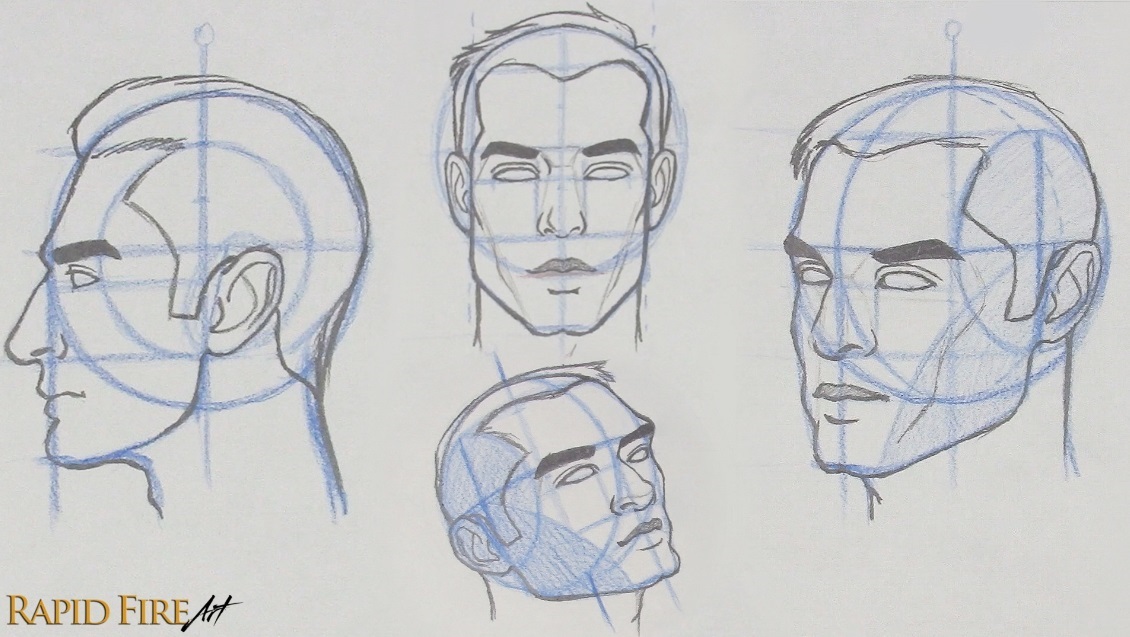
Are you good at drawing facial features from the front or side but struggle with other angles? Today I’m going to share a quick and fun DIY method for making simple 3D models that you can move around to explore facial features from any angle. These are very rough models, just enough to help you think through placement and structure when reference photos aren’t available. You’ll still want to study real faces to draw them realistically, but this can make certain angles a lot easier to wrap your head around.

This eye model was made using a kneaded eraser.

If you don’t have any molding clay, Play-Doh or even a kneaded eraser, you can follow the recipe below to create something that feels similar to Play-Doh. If you already have molding clay, you can skip the recipe section and go straight to the section on how to form a 3D eye, nose, and head model.

Simple Non-Toxic PlayDoh Recipe

To make this non-toxic Play-Doh from scratch, you’ll need:

In a small bowl, mix the salt and flour well. Then add the dish soap in and mix again. You can add a few drops of food coloring if you like. Once the mixture starts clearing the sides of your bowl, feel free to get in there with your hands for a more thorough mix. I found this recipe just right for me, but since it’s likely we won’t be using the exact same ingredients, here are some troubleshooting tips for you:

  1. Mixture too dry? Add more dish soap
  2. Too wet? Add more flour
  3. Too crumbly? Use less salt

Our goal is to get a consistency that is easy to shape without falling apart, crumbling, or being overly sticky. Here’s a test! Can you create a pointy tip (like the end of a witch’s hat) without it falling apart? If it’s falling apart now, it will become worse as you play with it because exposure to air will dry it out further.

Notes: The salt acts as a preservative, so you can keep this Play-Doh in an airtight container for a few months without it getting moldy. Avoid using oil as a substitute for the dish soap because it can actually ruin your drawing if it comes in contact with your paper, even just briefly.

How to Form 3D Models of Facial Features

Making a 3D Eye Model

  1. Create the Eyeball: Roll a piece of Play-Doh into a ball and set it aside.
  2. Create the Eyelids: Roll another ball around the same size as the first one and flatten it down (don’t make it too thin or else it will be difficult to peel off your work surface. 3mm to 4mm worked nicely for me). Cut it in half using a straight edge such as a ruler or butterknife. These halves will be the top and bottom eyelids.
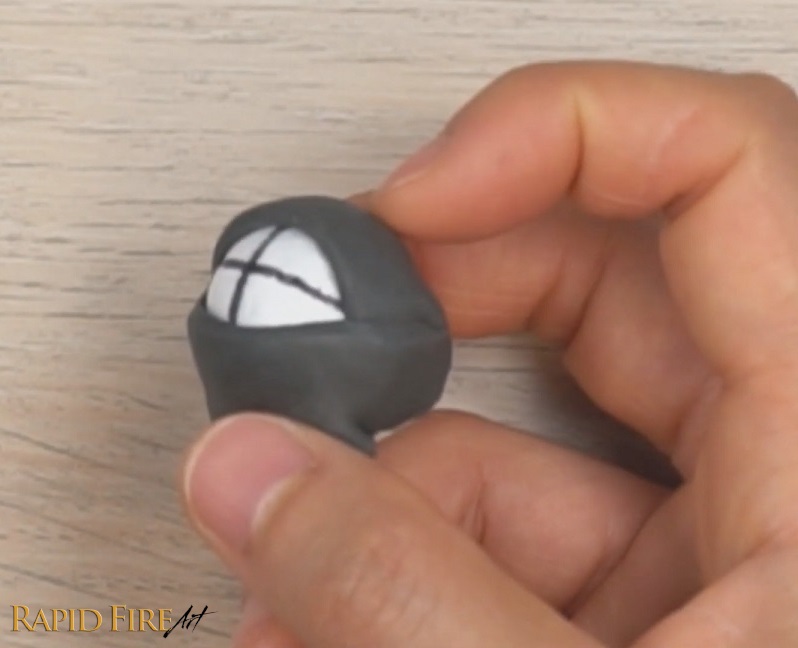
  3. Assemble the Eye: Place the two lids onto the ball, leaving a football-shaped opening to form the eye. Pinch the two lids together so they stay put.

Think of this model as a sketching aid. Rotate it, explore an angle, then translate that view directly into your drawing. It was very helpful for me when practicing the Loomis head drawings.

Making a Nose Model

  1. Create the Base: Form a wedge shape with a trapezoid at the bottom.
  2. Add Nostrils: Attach two round pieces on the sides for the nostrils. Press them in until they look more like half-spheres.

A blocky model like this trains your eye to think in 3D rather than copying outlines and makes proportion or orientation errors easier to spot and fix. Keep it next to your desk as a handy reference tool.

Making a Model Head

  1. Prepare the Base: Make a ball using your play-doh or better yet, a styrofoam ball and pierce it with a toothpick through the very center.
  2. Mark the Lines: Draw a vertical and horizontal line around the ball, ensuring they form a 90-degree angle and that the vertical line goes through the North and South Pole.

These lines help inform where facial features should go when the head is tilted at any angle. Find out more by exploring my tutorials on drawing the head.

You can also convert this into an eye model to help with positioning your pupil correctly (the vertical and horizontal line marks the position of the pupil).

how to make an eye model for drawing reference

Using Your Drawing Models

These models are simplified representations of facial features and the head. They can help you understand how features might look from challenging angles, especially when your reference image isn’t clear or available. Rotate the model to study foreshortening and observe how planes shift or disappear from view. This kind of practice helps build a mental library for drawing from imagination, but it doesn’t replace studying real faces.

Maintaining Your Play-Doh

If your Play-Doh starts to dry out, remove hardened or flaky bits and then knead it well. Store it in an airtight container or Ziploc bag to keep it usable for months. For a longer-lasting alternative that doubles as an eraser, check out my tutorial on how to make putty erasers from common household items.

Hope you had as much fun making these as I did!

Darlene

How to Make DIY Models to Enhance Your Drawing Skills Read More »
How to Draw Lips – 8 Steps | HB Pencil

How to Draw Realistic Lips Using HB Pencil

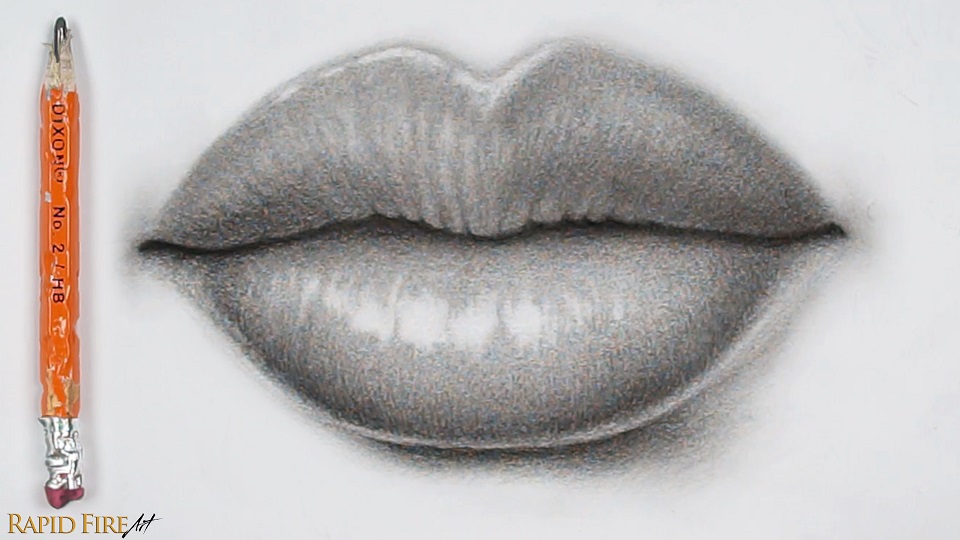
In this tutorial, I’ll be using a cheap HB pencil from the dollar store and a regular facial tissue to draw a pair of plump, realistic lips. This tutorial is adapted from my video instruction on Youtube and further simplified.

Tools:

  • Cheap Dixon dollar store HB pencil with eraser on the end
  • Ordinary facial tissue
  • Printer paper

Step 1: Lip Construction

How to Draw Lips HB Pencil

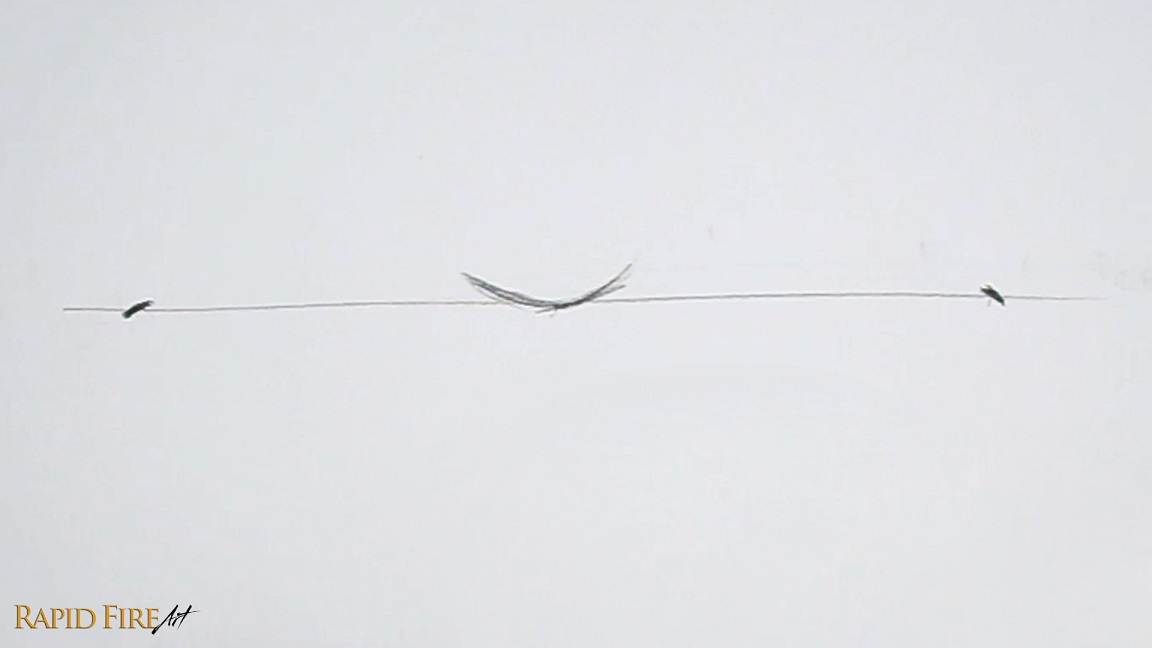
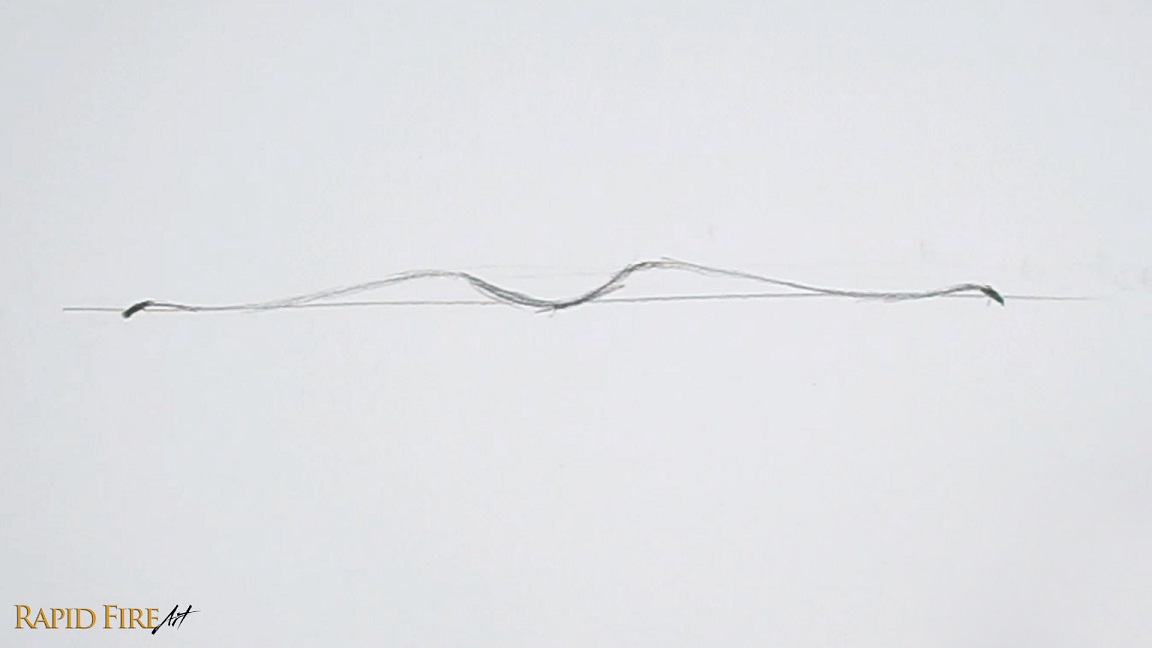
Start by drawing a long horizontal line across your page. In the middle, draw a shallow “U” shape. On each side, draw the corners of the mouth using little tick marks. Make sure they are spaced evenly apart.

Note: My line is approximately 18cm wide, in case you want to match it.

How to Draw Lips HB Pencil Construction

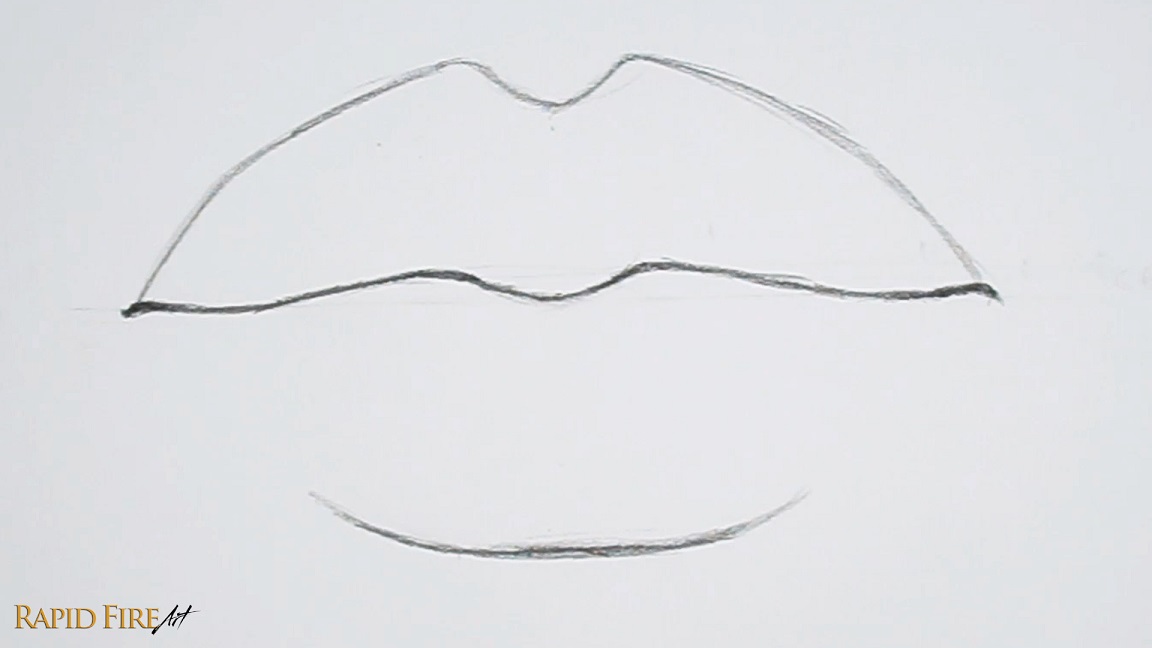
Now connect the shallow “U” and tick marks together using a wavy line. Once done, erase the horizontal line.

How to Draw Lips Outline

Draw the top and bottom lip. If you want to draw your lips narrower, you can reduce the vertical space.

Step 2: Shade Lip Base Layer

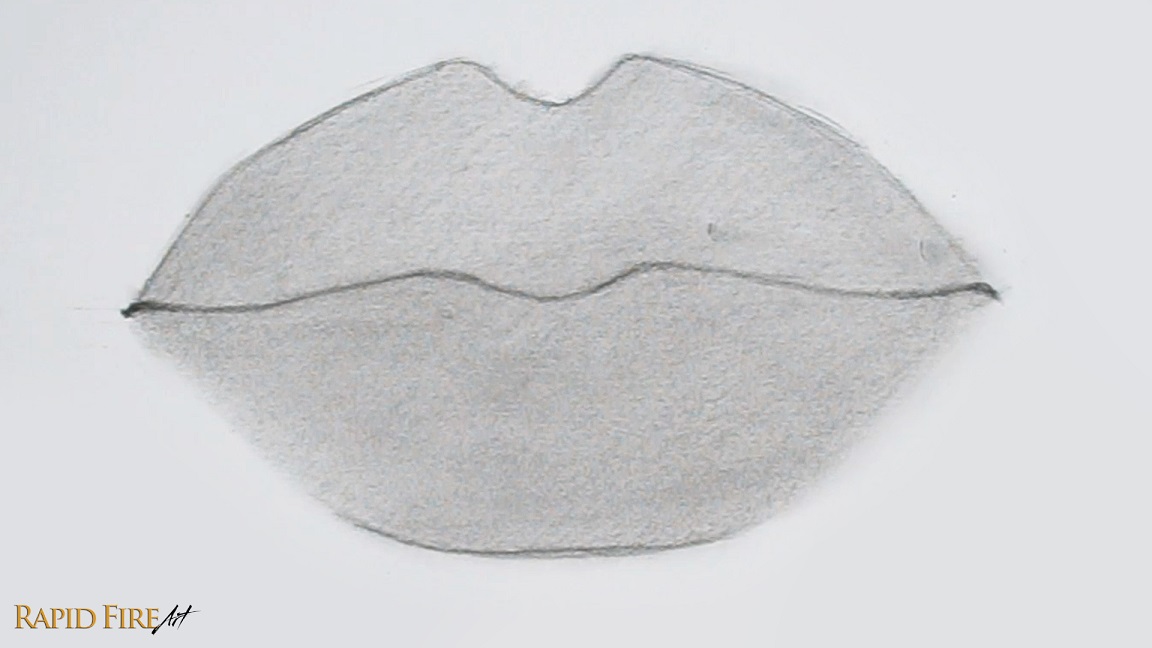
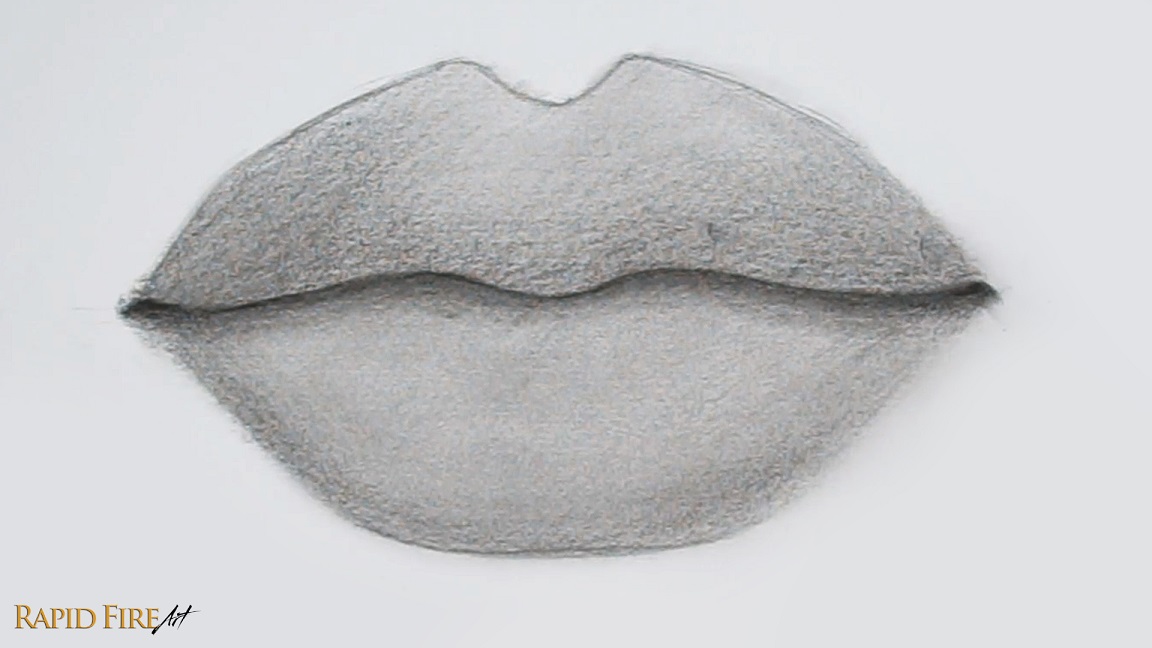
Sharpen your pencil to expose as much graphite as possible. Then use the side of your graphite to shade thick strokes across both lips. Just focus on shading a solid, medium tone. Keep your pencil strokes close together to reduce gaps and achieve a smooth shade.

Tip: Holding your pencil with an overhand grip versus a writing grip will help you achieve thicker strokes. Visit my shading tutorial to learn more.

Then blend using any tool of your choice. I’m using a regular facial tissue wrapped around the padded part of my index finger.

Step 3: Add Shadows

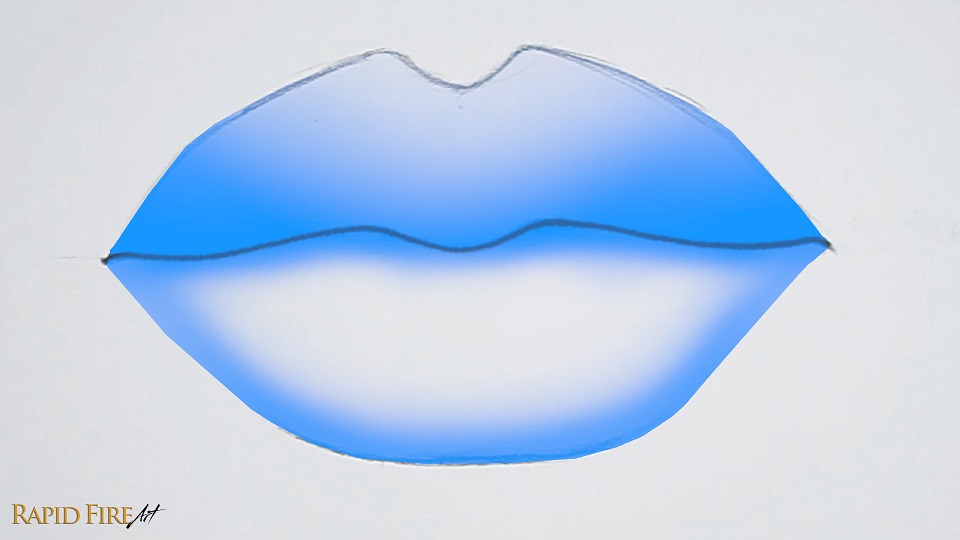
My imaginary light source is shining down from the top left. So I will shade the areas highlighted in blue a little bit darker to give the lips some shape. We will be shading them even more later.

How to Draw Lips_Shading

Blend again. Make sure to blend from light to dark to avoid smudging your work.

Step 4: Draw Lip Wrinkles

Let’s draw some lip wrinkles along the bottom of each lip to add some realistic texture to our drawing.

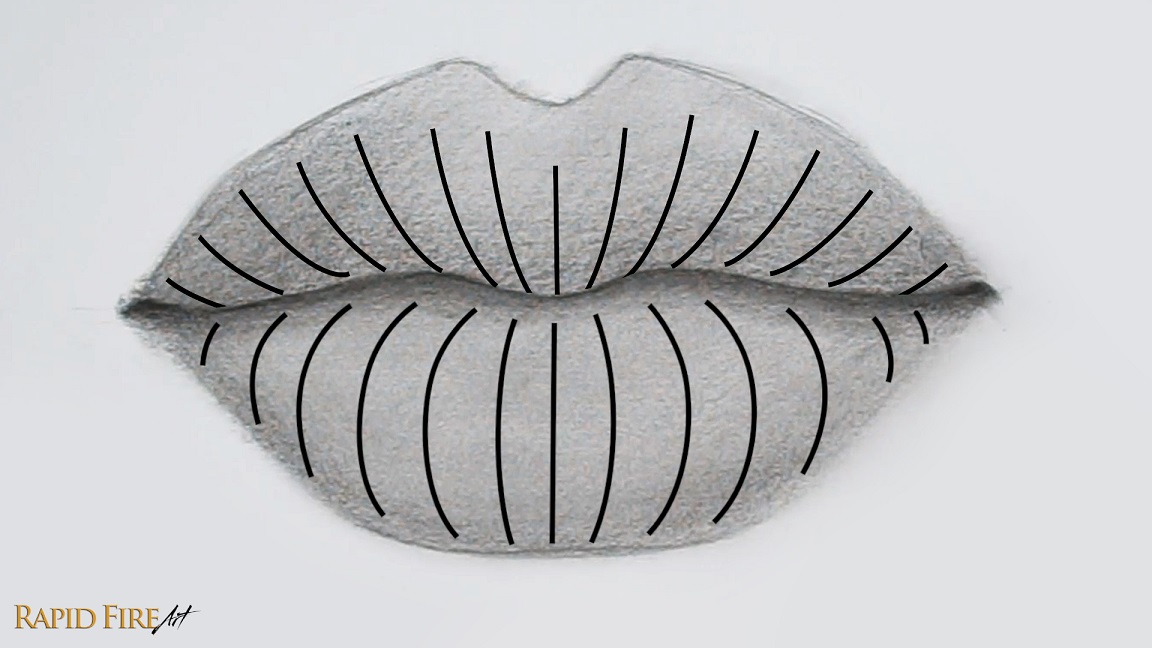
Lip Contour Lines For Drawing

The image above is a reference to help you see the contour of the lips. If you draw wrinkles using curved strokes like this, it will help support the illusion of plump lips. For this drawing, let’s mostly draw wrinkles along the bottom of each lip. Leave a tiny bit of space along the very bottom of each lip to account for reflected light.

How to Draw Lip_Wrinkles

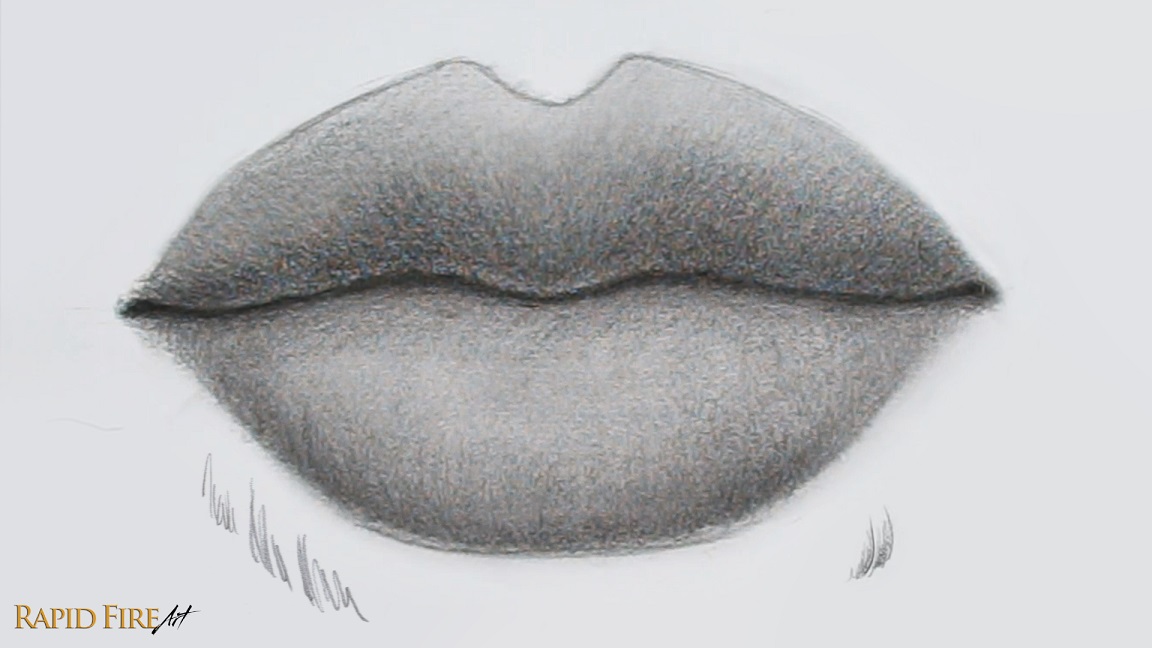
To draw wrinkles, use the tip of your pencil to get thin, clean lines. Vary the height and pressure of each line so the wrinkles can stand out and look natural. You can see an example of my strokes right below the drawing. Even though these marks look scribbly, layering several of them together creates surprisingly realistic wrinkles!

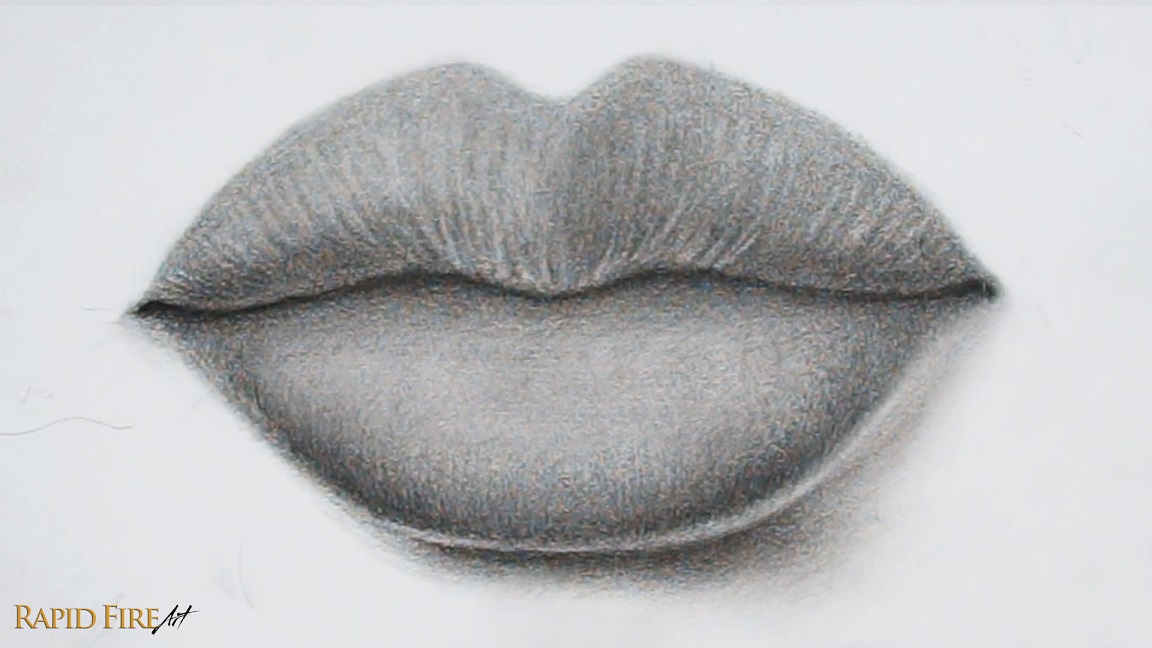
These new pencil strokes should double as shading to further shape the lips. So aim to draw these darker than the shadows you did in step 3. Try your best to fade out as you flick your strokes upward so the transition between light and dark is gradual.

If you want to soften up all these wrinkle textures so they are more subtle, blend your work slightly.

Step 5: Add More Shadows

How to Draw Lips HB Pencil_Cast shadow

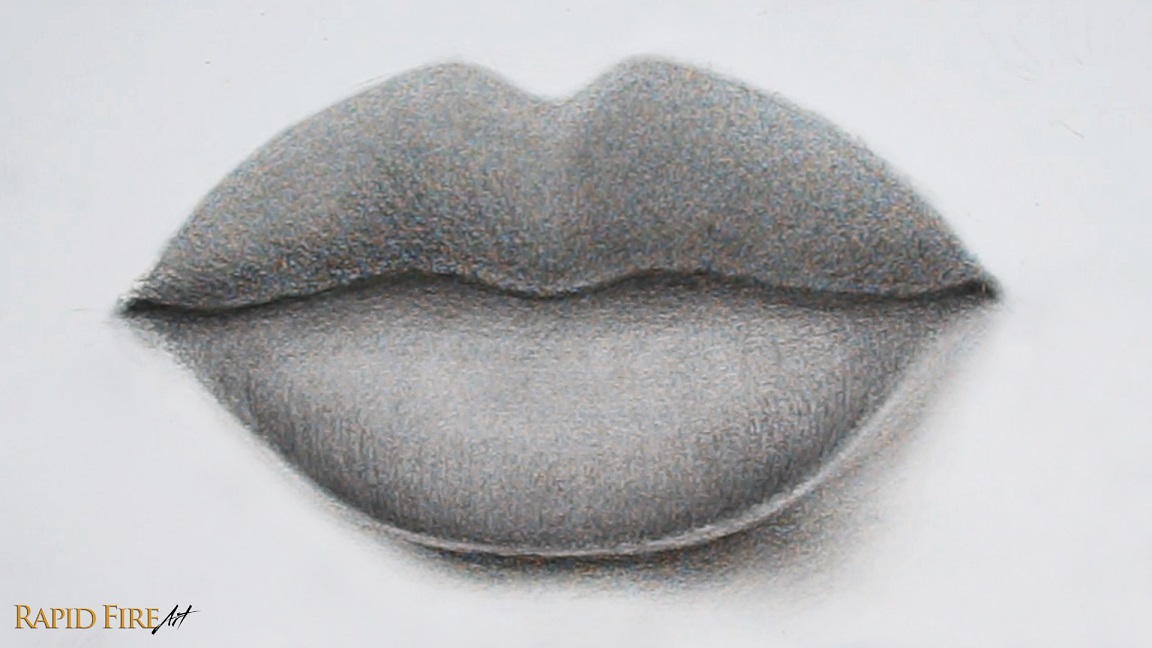
Add a cast shadow below the bottom lip and blend it very well. Since our light source comes from the top left, the cast shadow will be seen mostly along the bottom right.

Check to see if the outline of your top lip is still visible. If it’s very apparent, lighten it as much as you can and then shade the lip a little darker until it disappears.

Since our light source comes from the top left, the right half of the top lip will be in shadow, so shade it a little darker.

Step 6: Add Lip Wrinkles Using an Eraser

How to Draw Lips HB Pencil_Top Lip Wrinkle Contour Lines

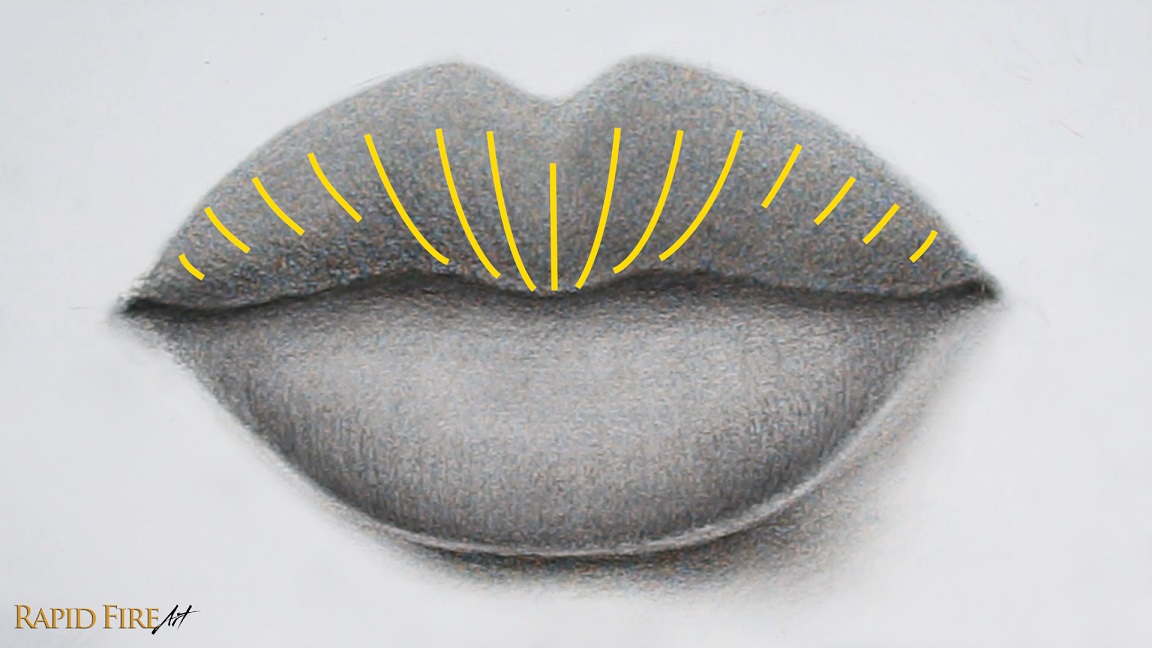
Let’s go along the top lip using our eraser to give it some more shape and texture. I’m going to erase along the areas highlighted in yellow. Curve each stroke to follow the contour of the lip like we did in step 4.

How to Draw Lips HB Pencil_Top Lip Wrinkles

Group your strokes close together and vary the length of each one, trying not to create a noticeable pattern.

Tip: Use your eraser like how you would normally draw, using light pressure to erase subtly and more pressure to erase brighter strokes.

Once done, blend to make the wrinkle lines appear softer and more natural.

Step 7: Add Highlights

How to Draw Lips HB Pencil_Highlights

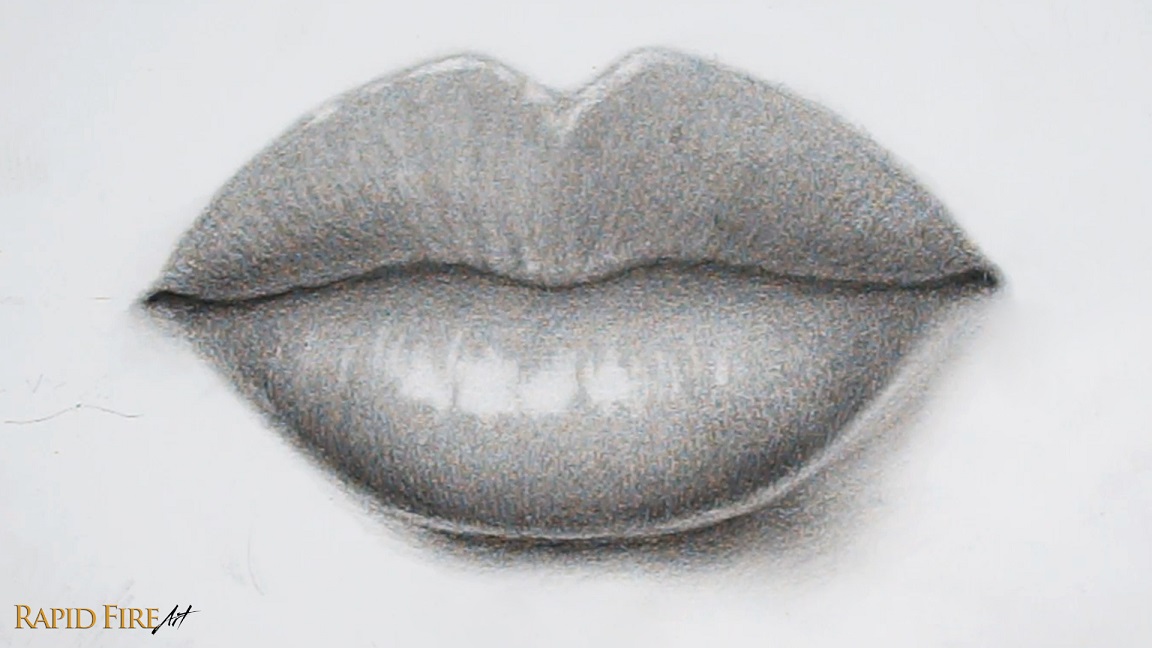
Highlights are the brightest areas of our subject, where the light source hits directly. Since our imaginary light source comes from the top left, we’ll avoid placing highlights along the bottom or right side of the lips.

I’m using an eraser to create these details. Vary your strokes so you have a variety of long, short, wide, and narrow ones. If you want your lips to look glossy, make the highlights more connected.

When making vertical highlights, curve your strokes to follow the contour of the lip (refer to the contour lines from step 4).

Step 8: Additional Details

How to Draw Realistic Lips HB Pencil

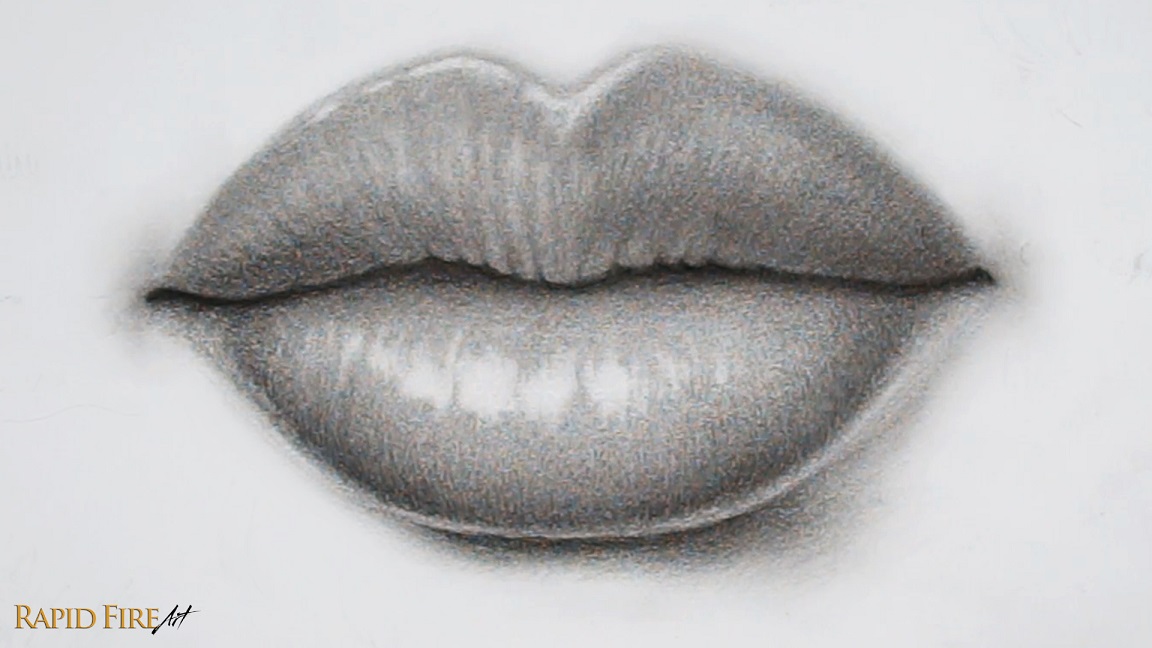
Optionally, you can make the skin of your top lip appear bunched up.

How to Draw Lip Wrinkles

This can be done by first drawing triangle shapes along the bottom edge, avoiding the sides of the lip. Then, from the top of each triangle, flick your pencil up to create deep wrinkle lines that fade out at the top.

If you already have some prominent wrinkles along your top lip, pick a few and draw your triangles at the base of each.

Between each of these new wrinkles, lighten the skin slightly to make the surface look raised.

A few more tweaks…

If you want to make your drawing pop more, you can increase the contrast by making sure the highlights are as light as you can get them and darken your shadows even more to improve depth.

Around the corners of the lips, shade slightly and then blend well to achieve a very slight dip in the skin. You can blend around the outer edge of both lips to soften them.

I hope this tutorial on how to draw realistic lips using an HB pencil was clear and easy to follow. If you got stuck or need clarification on any steps, please check out the original video tutorial where I walk you through each step and explain things in more detail with additional examples.

Happy drawing!!

Darlene

How to Draw Lips – 8 Steps | HB Pencil Read More »
How to Draw a Teary Eye in 12 Steps

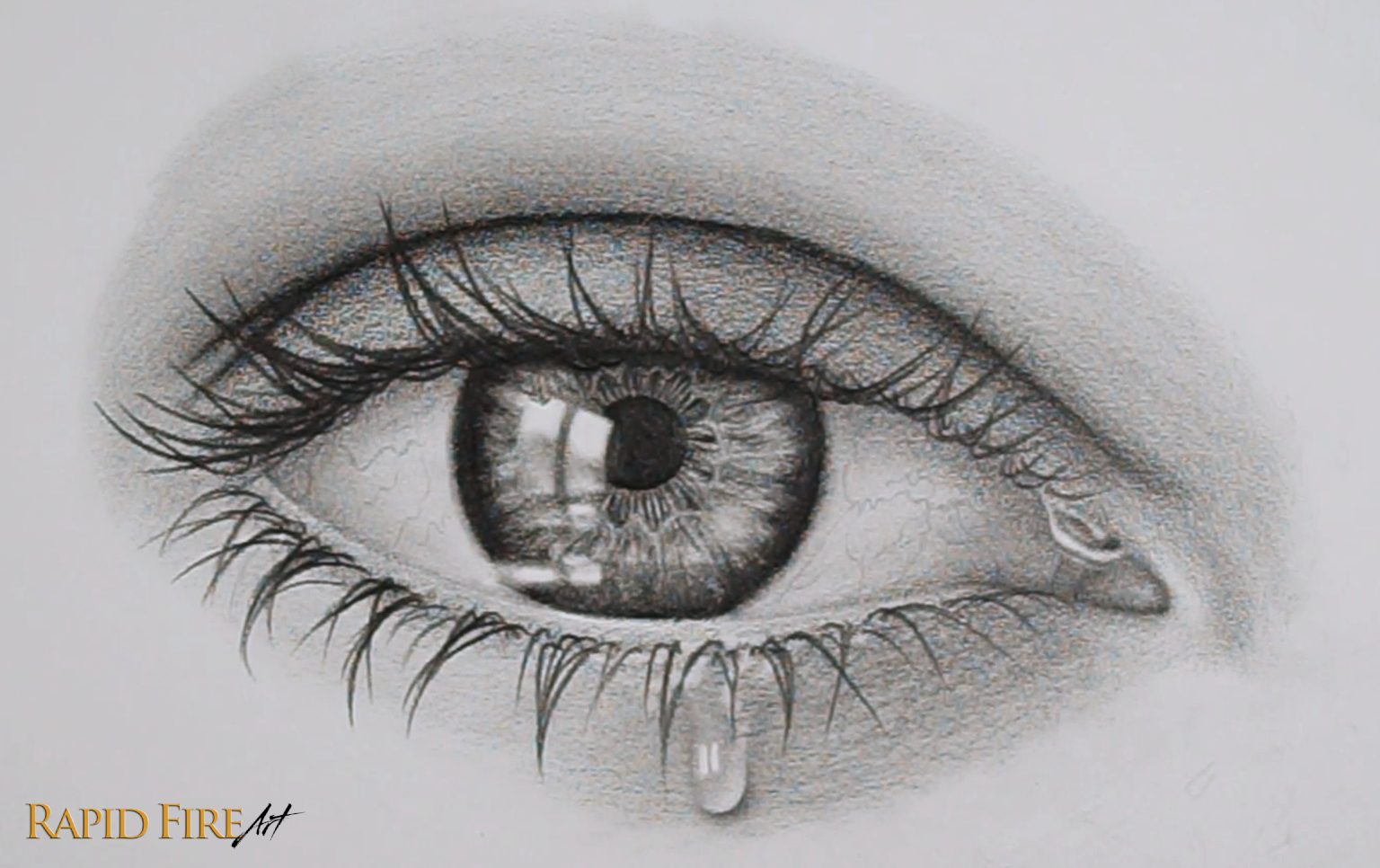
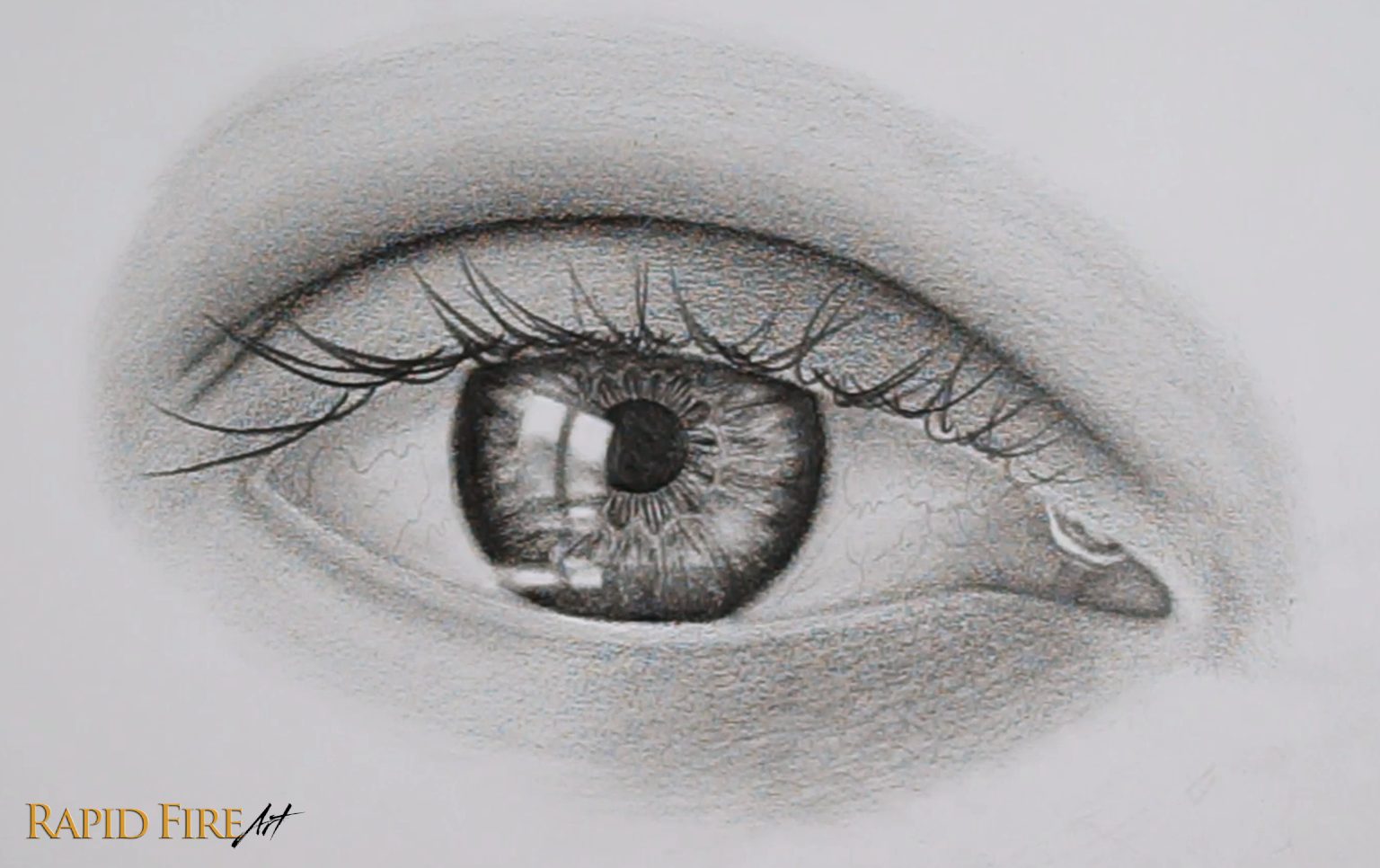
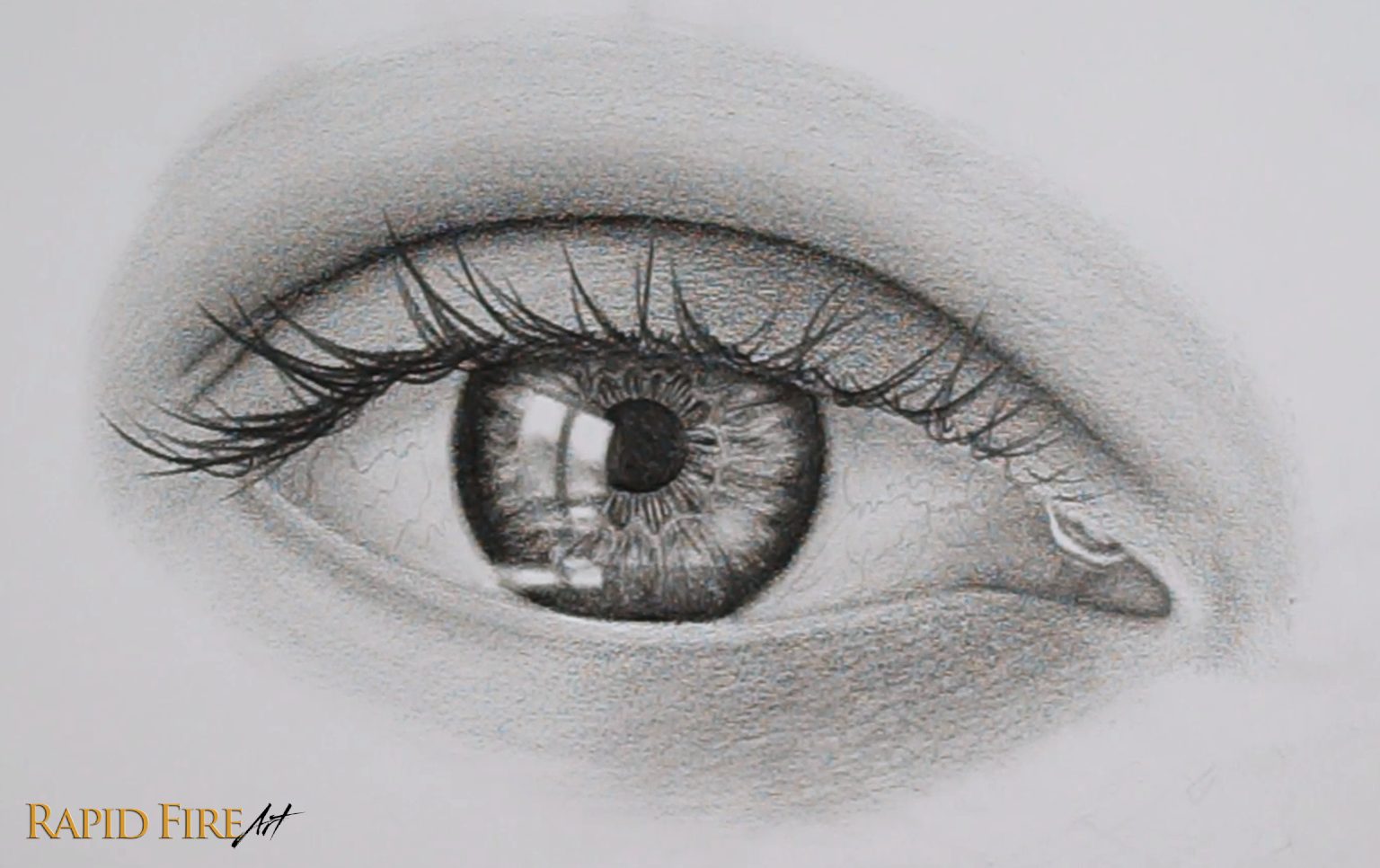
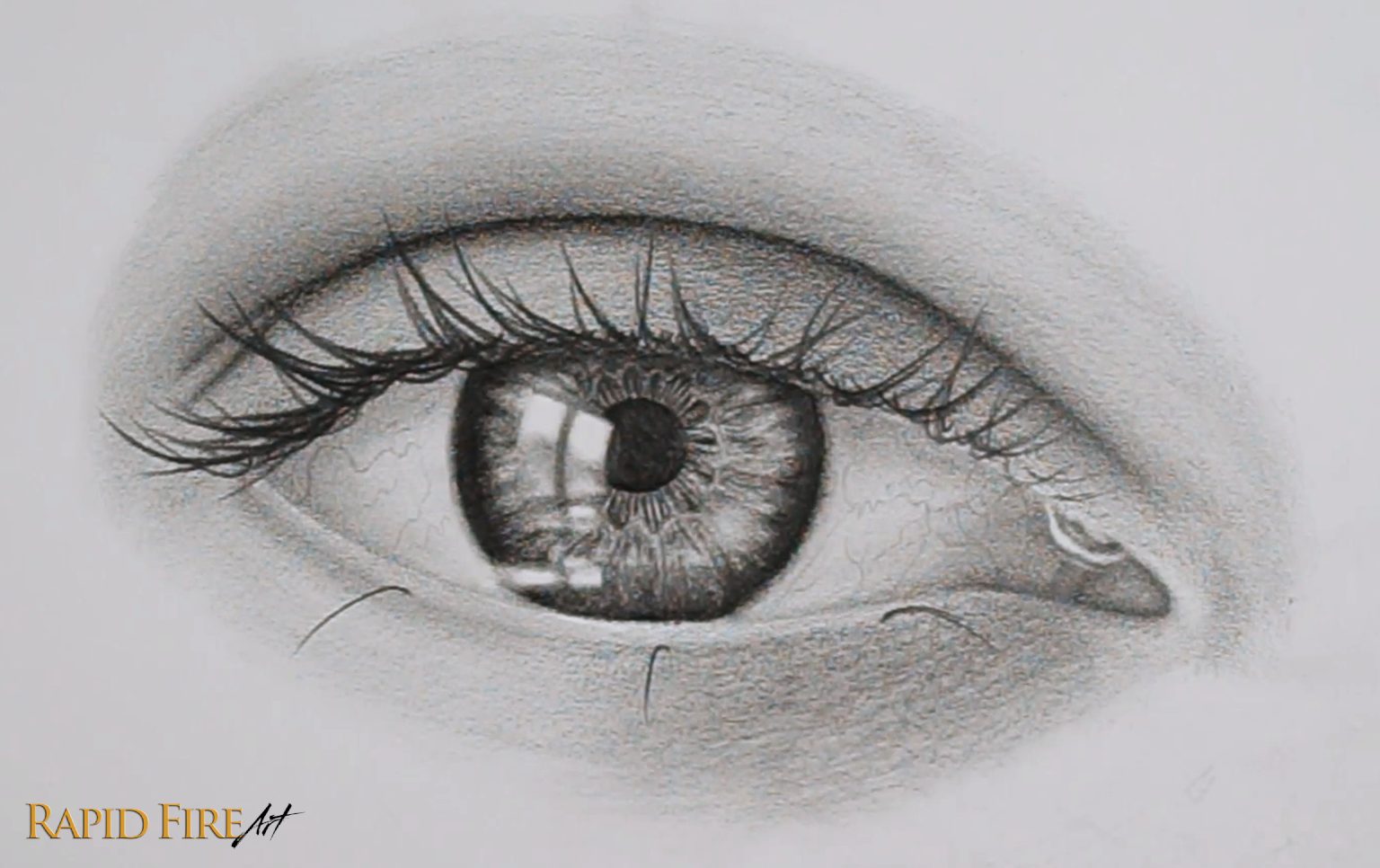
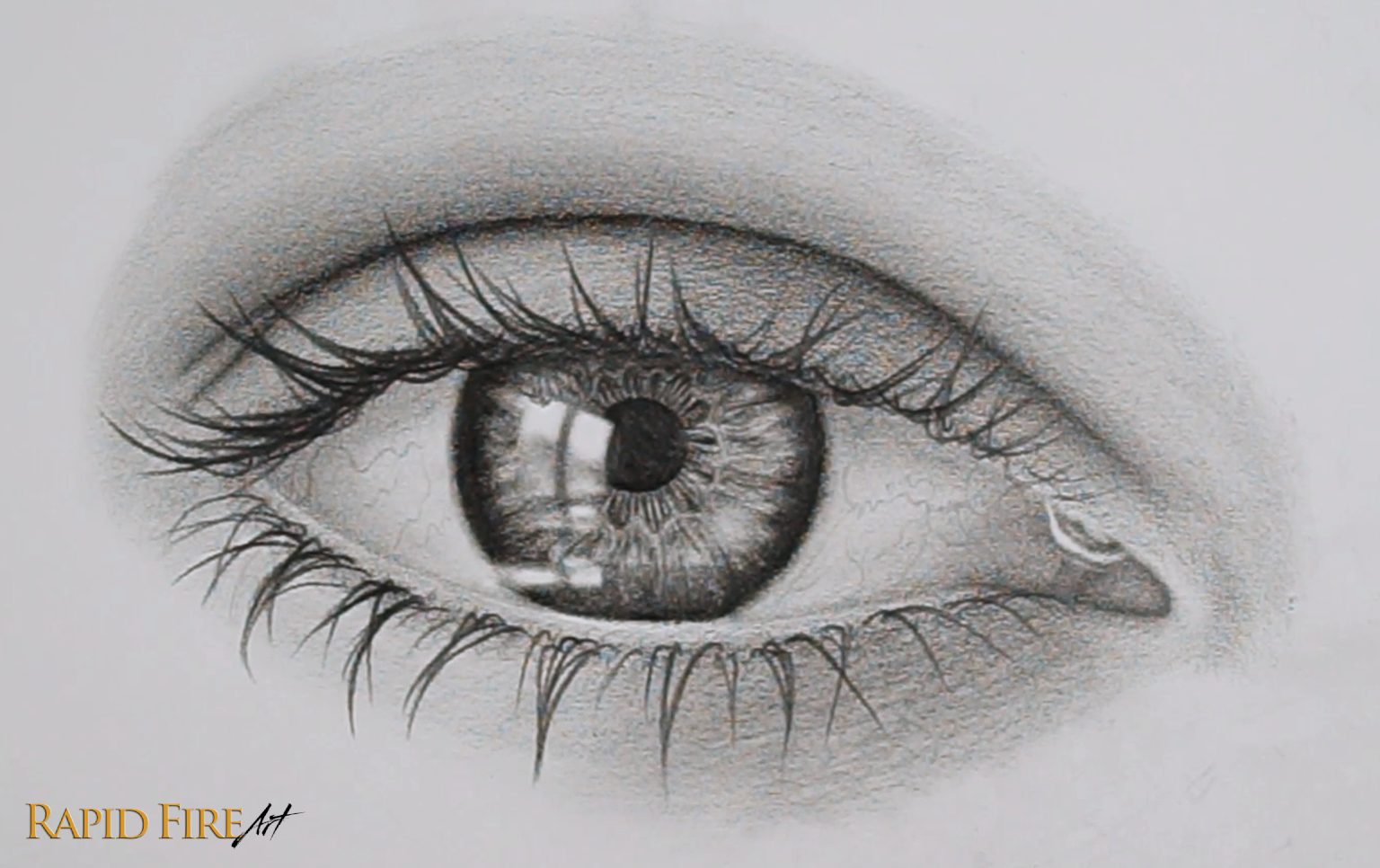
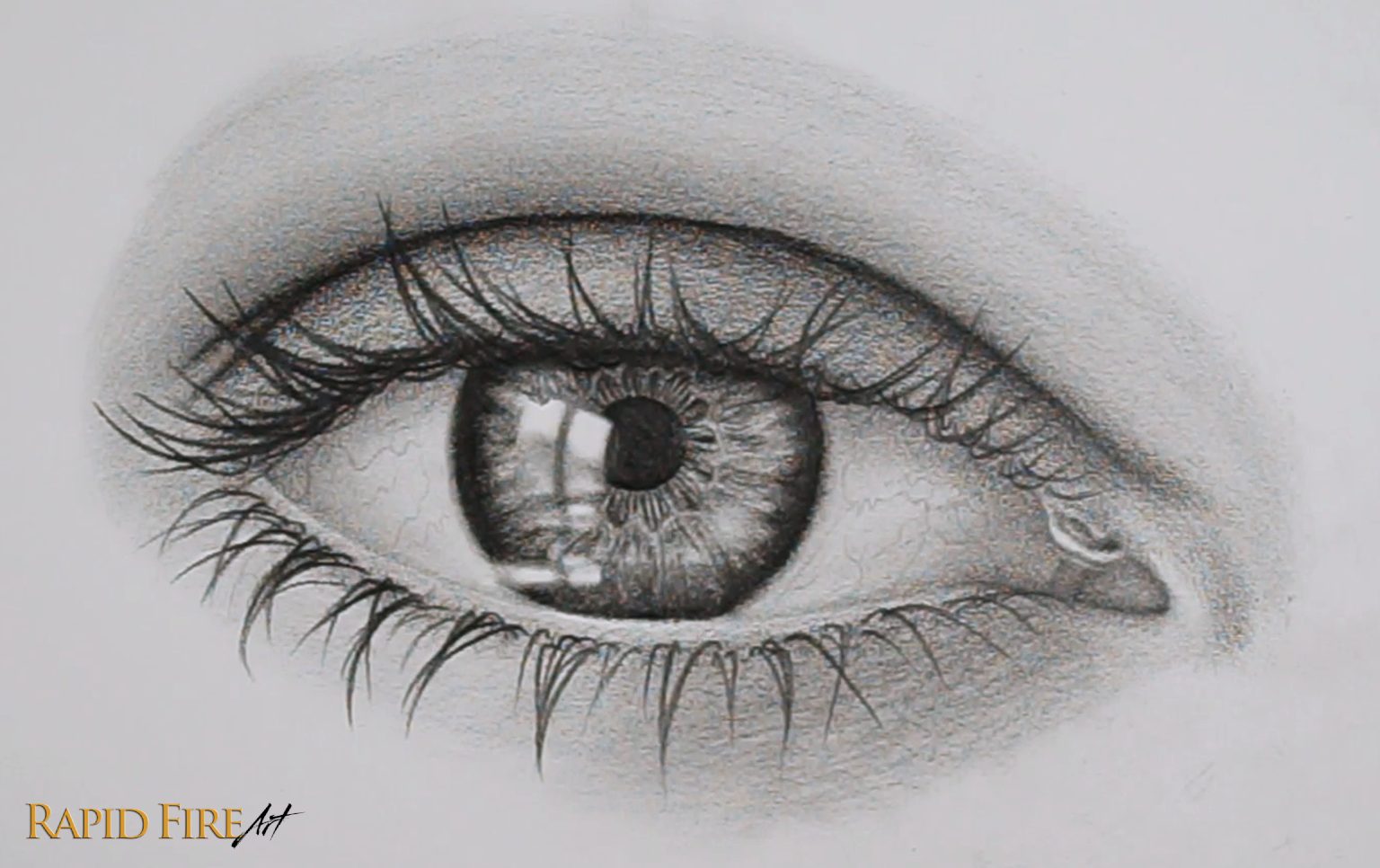
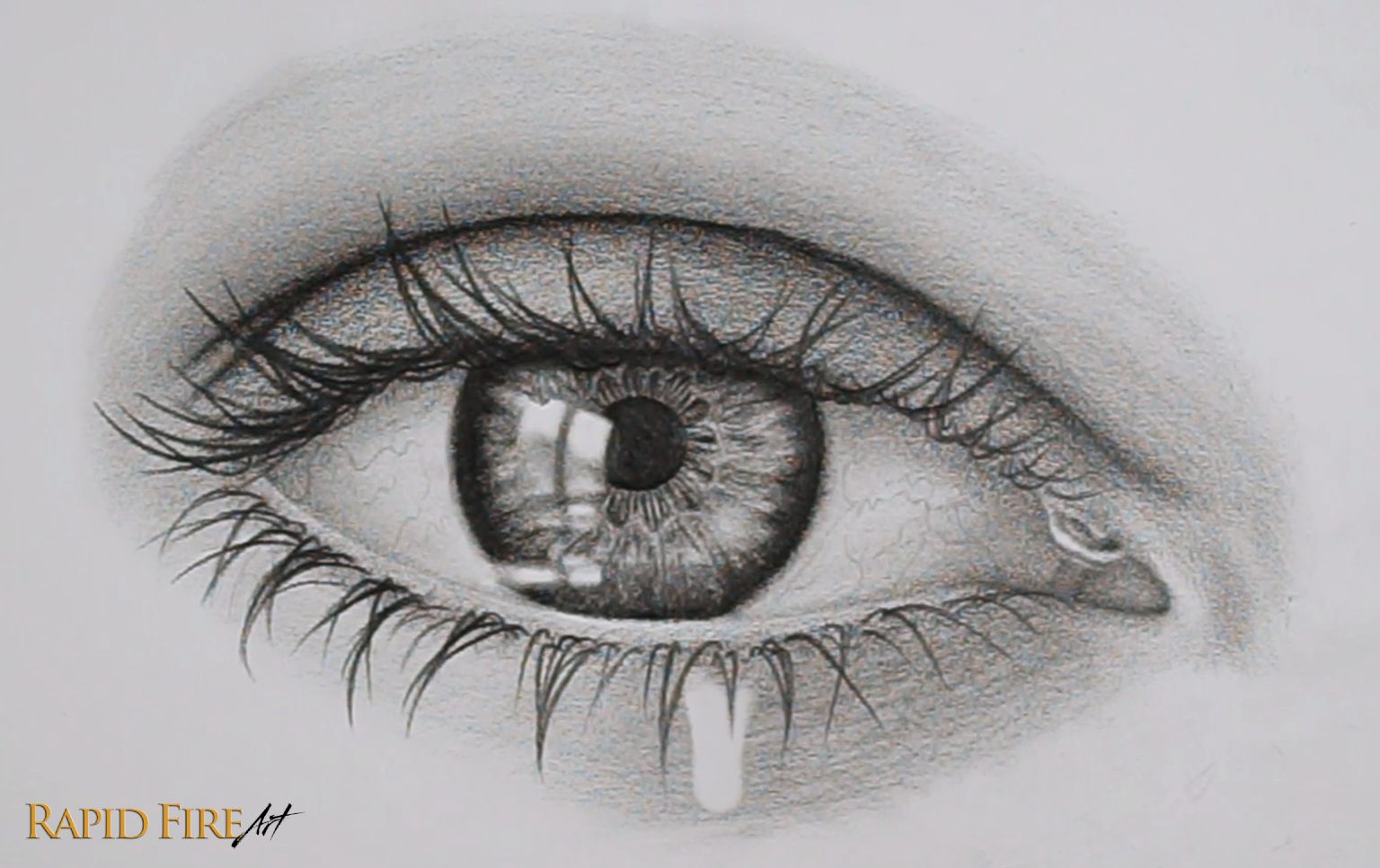
How to Draw a Teary Crying Eye Step 12_2

Hey guys! It’s been a while but I’m back with a new tutorial! Learn how to draw this realistic crying eye from scratch in just 12 steps. This condensed tutorial was made using screenshots taken from my hour-long video tutorial on Youtube. Please refer to the teary eye video if you need any extra explanations for any of the steps below 🙂

Tools I used:

Kneaded Eraser: For erasing fine details or blemishes. (Learn how to make one from scratch!)

Mono Solid Eraser: For erasing quickly and cleanly.

Staedtler Graphite Pencils: 2H,HB,2B,4B,6B

Blending Stump: Great for blending details and dark zones. (Learn how to make one)

Tissue Paper: Great for blending evenly. Helpful for lightening areas shaded too dark because the tissue lightens the drawing slightly as you blend.

Canson Drawing Paper: This paper allows for a lot of layering.

White Gel Pen: Optional. To make your brightest zones pop!

SmudgeGuard Glove: Drawing glove to prevent smudging and the transfer of oils from your hand.

Note: If you only have a school pencil (HB) and solid eraser, you can still achieve similar results, except your drawing may appear a bit lighter in value.

Step 1: Construct the Eye Shape

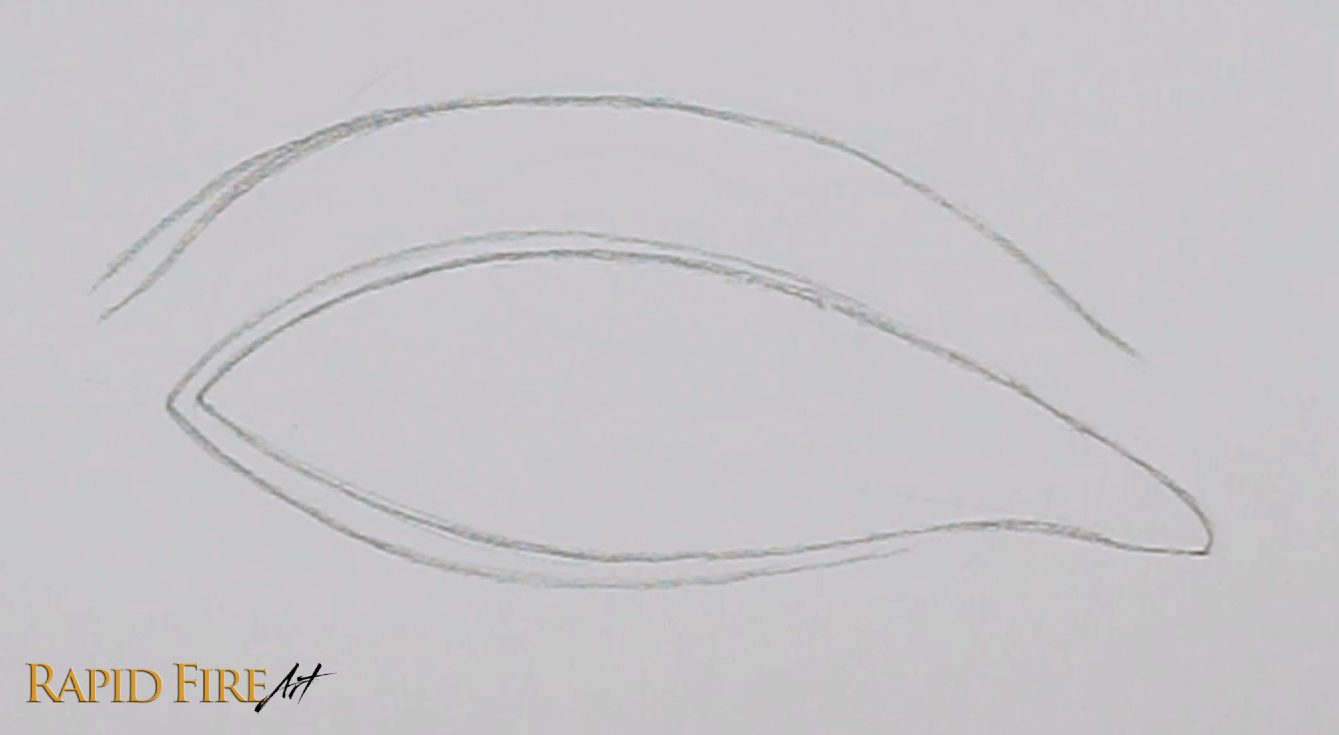
Lightly draw the shape of an eye using your HB pencil. Draw an eyelid crease above it. If you need help with this step, the video tutorial breaks it down further.

Since we’re going to add a lot of detail to this eye, I would recommend you draw it a similar size as mine, which is about 12-13cm across.

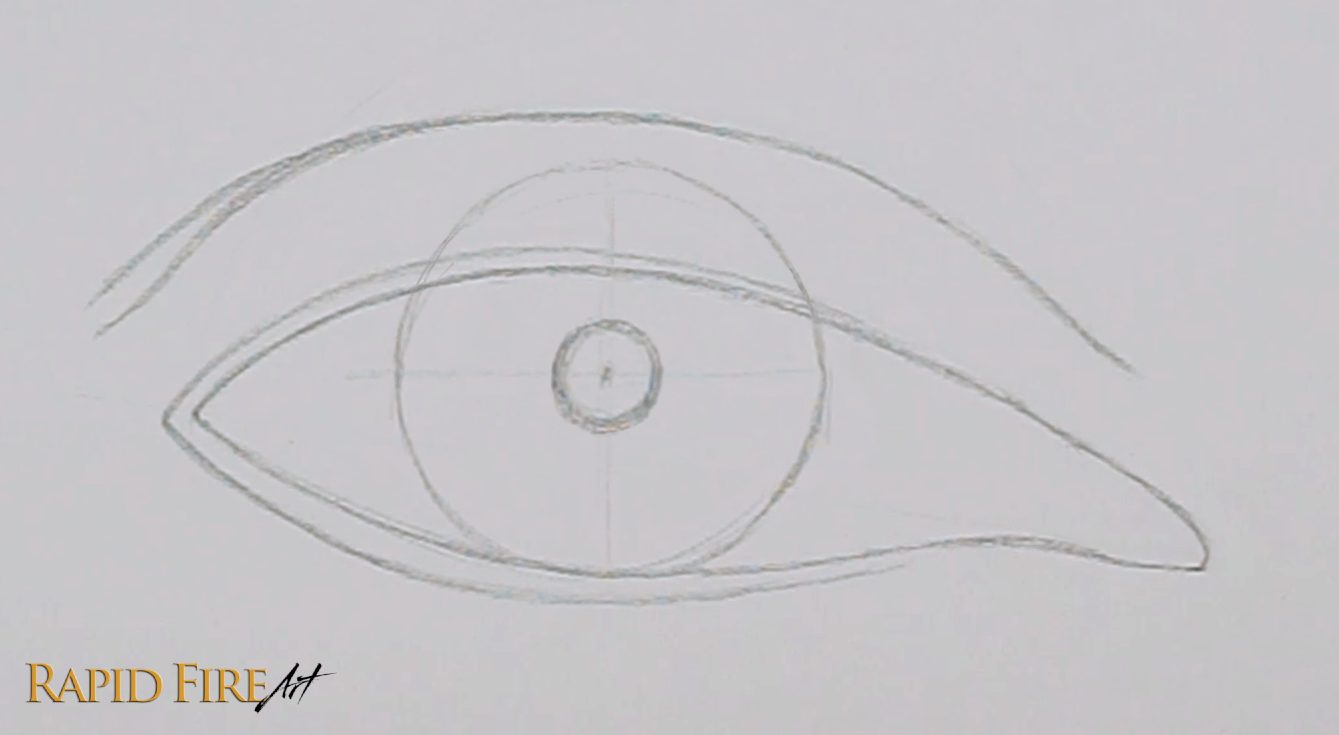
Step 2: Outline the Iris and Pupil

How to Draw a Teary Crying Eye Step 2

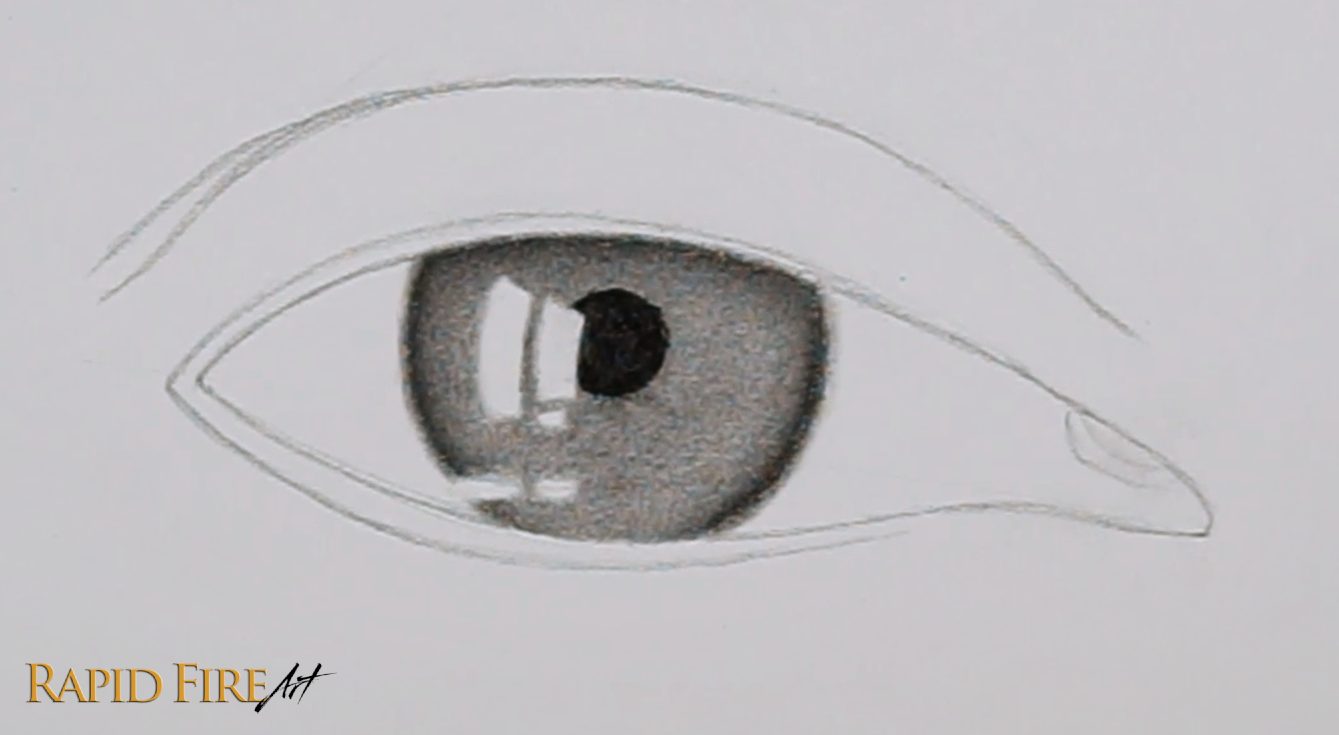
Draw a circle for the iris, making it roughly half the width of the eye. In the center of your iris, add smaller circle for the pupil, but don’t shade it in yet!

If you need help centering your pupil, draw a vertical and horizontal line through your iris. The point where the lines intersect marks where the pupil should go 🙂.

Step 3: Outline the Highlights in Your Eye

How to Draw a Teary Crying Eye Step 3

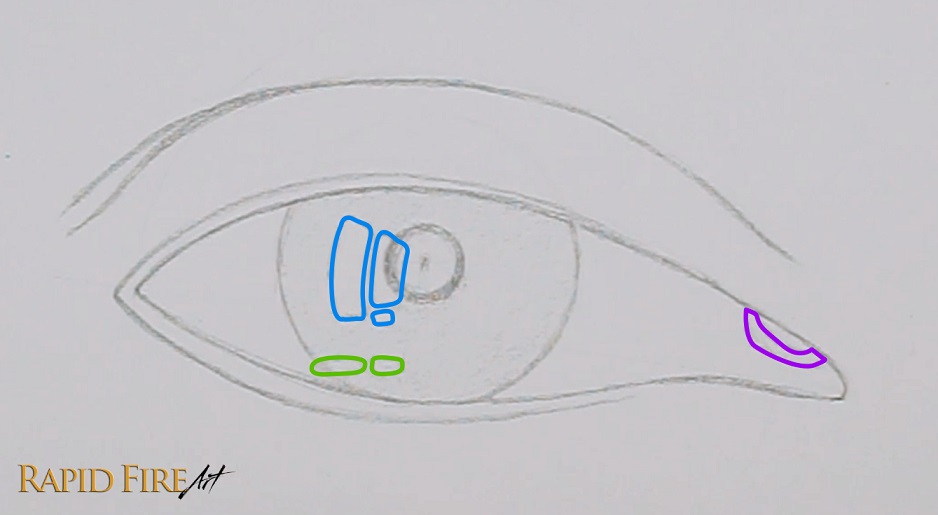
The magical part that makes an eye drawing look teary without overdoing the teardrops is the highlights. These are shiny areas that will make the watery parts of our eye glisten.

Let’s draw 3 groups of them…

  1. Main Highlights: Outlined in blue for your reference, these rectangle shapes are a reflection of a pair of windows situated to the left side of our imaginary room. It is curved to support the illusion of a curved eyeball. I broke the shapes down from 2 to 3, but you can simplify it more if you want.
  2. Waterline Highlights: Outlined in green, these two shapes are a squished version of the Main Highlights. I’m calling them Waterline Highlights because they are going to sit at the edge of some accumulated tears at the bottom of the eye, and we want these tears to glisten!
  3. Inner Corner of the Eye Highlights: Outlined in purple. When our eyes well up with tears, they always collect at the inner corner of the eye because that’s where the tear duct is located. Let’s outline a big “U” shape to make this area really wet-looking.

Step 4: Shade the Pupil and Iris

How to Draw a Teary Crying Eye Step 4_1

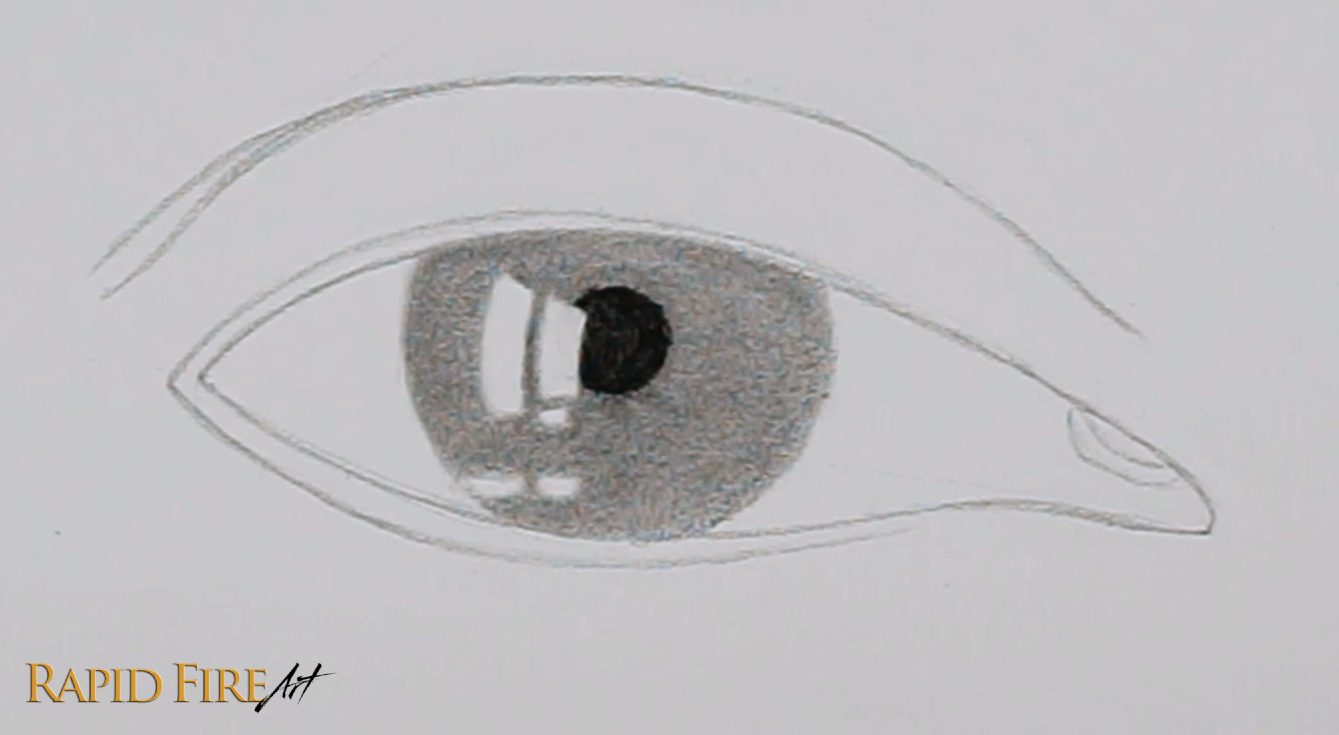
Shade your pupil as dark as you can get it. I used a 6B pencil for this. If you are using a harder pencil like an HB, avoid pressing too hard because it can warp the paper and/or make it overly reflective.

Then shade your iris. Start with an even layer of graphite (4B) and then blend it with a tissue.

How to Draw a Teary Crying Eye Step 4_2

Then, using a 6B, shade a dark ring around your iris. Since my imaginary light source is shining down from above, the eyelid will cast a shadow along the very top of the eyeball. So let’s shade along the very top of the iris to account for this cast shadow.

I prefer to blend these dark parts with a blending stump because the tissue tends to lift graphite away, making the area lighter. The advantage with blending using a tissue is that it’s easier to work with if you are a beginner and the result looks smoother.

Step 5: Draw Iris Details Part 1

How to Draw a Teary Crying Eye Step 5

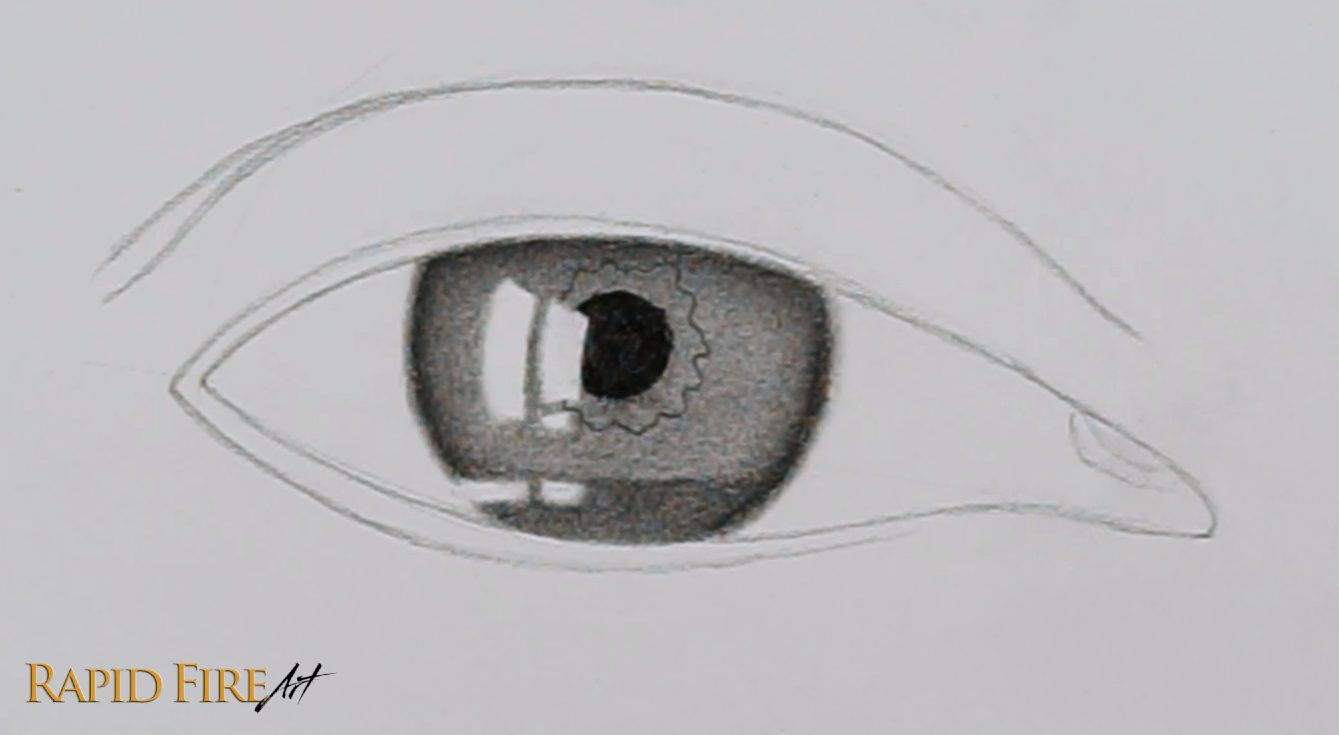
Still using a 6B pencil, shade a dark band along the very bottom of your iris for the accumulated tears. Only shade as high as your Waterline Highlights.

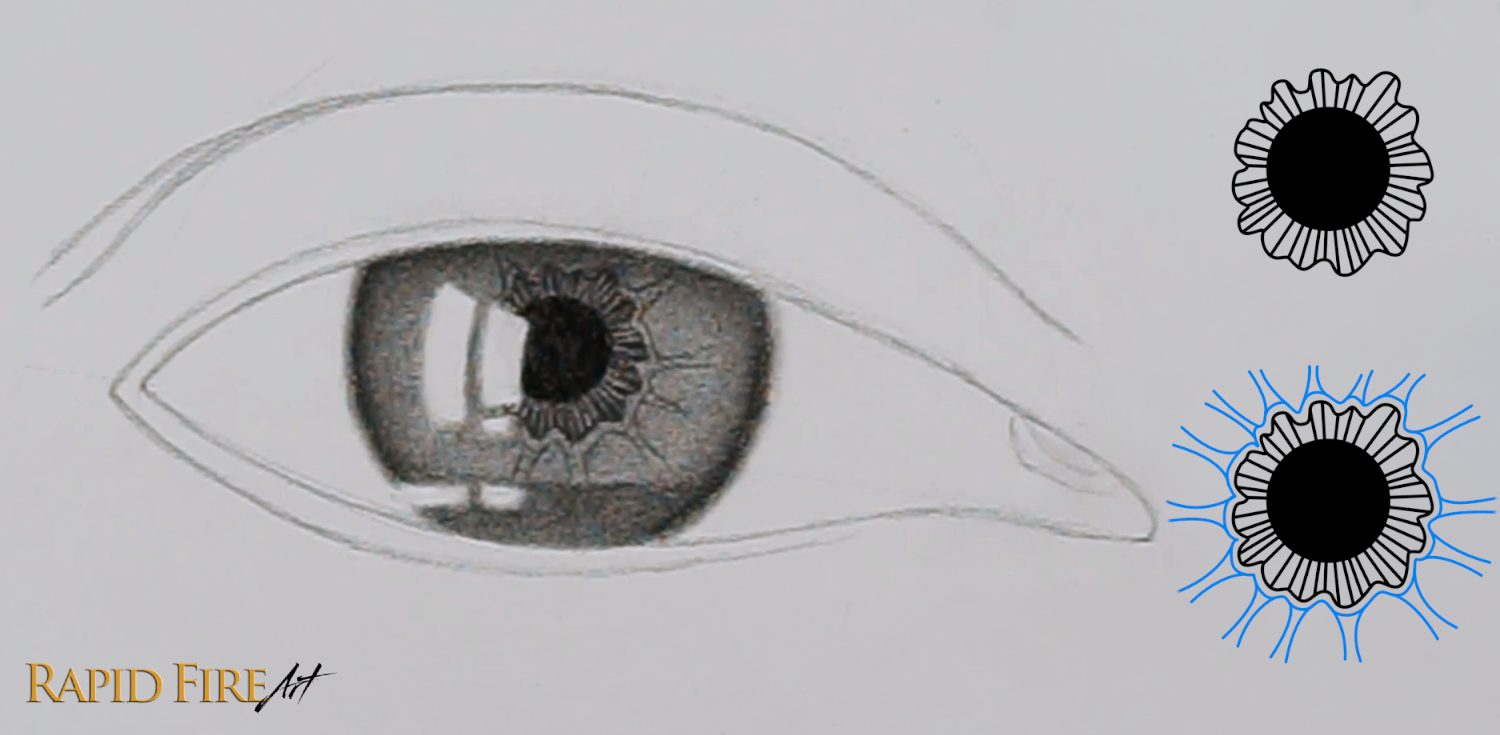
Next, draw a wavy ribbon around your pupil using a 4B pencil.

Step 6: Draw Iris Details Part 2

How to Draw a Teary Crying Eye Step 6_1

Within the ribbon that surrounds your pupil, draw a bunch of radiating lines. Then draw another identical ribbon around the first one. Where the ribbon juts out, draw lines that reach outward toward the edge of the iris.

How to Draw a Teary Crying Eye Step 6_2

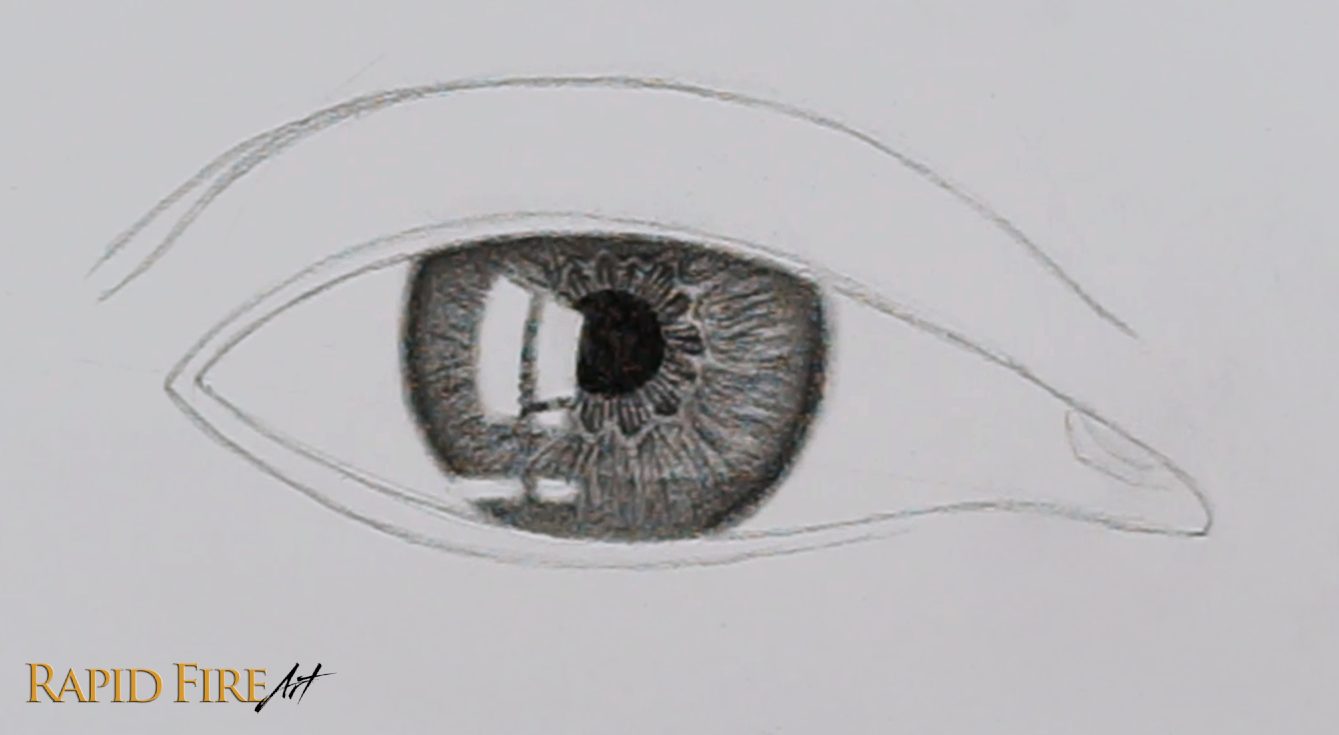
Continue drawing a variety of wavy/squiggly lines radiating towards the edge of the iris. Lighten the spaces in between your pencil marks using your kneaded eraser if you want to make some of the spokes pop out (this increase in contrast can help make your eye look more captivating).

How to Draw a Teary Crying Eye Step 6_3

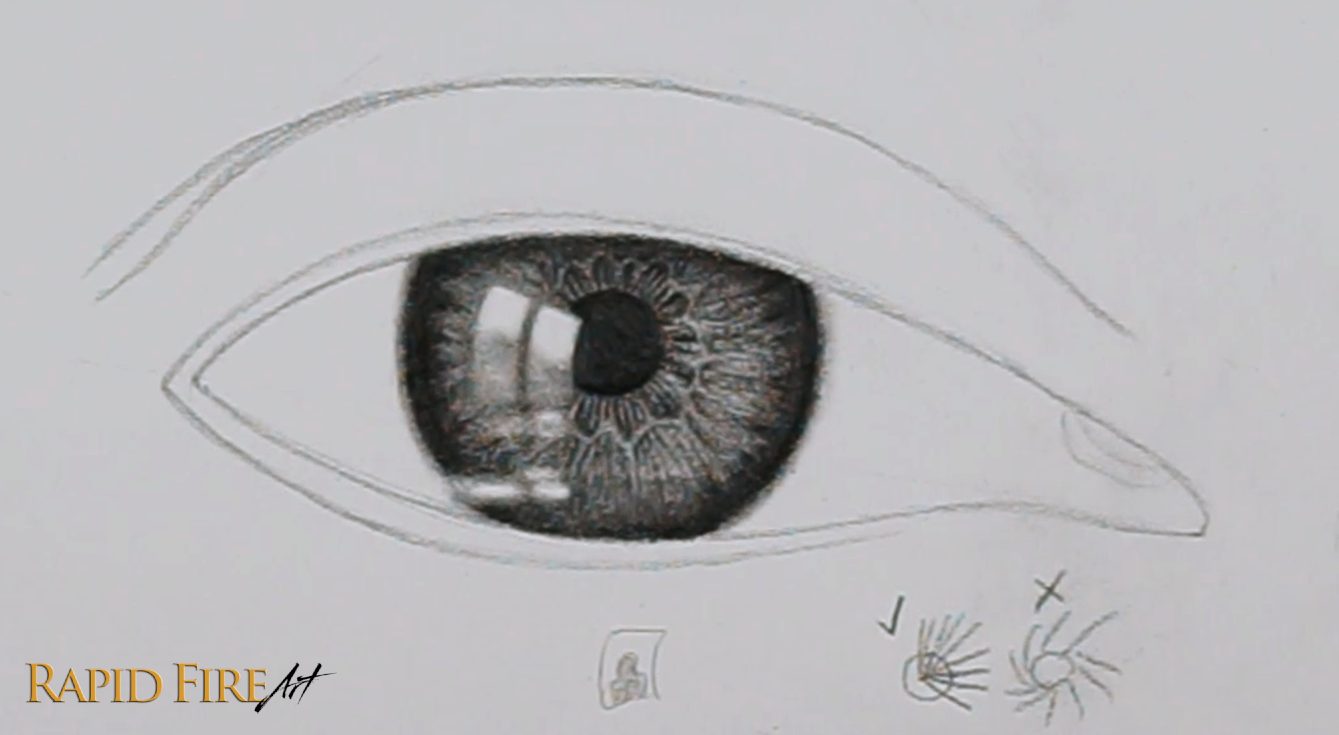
You can increase contrast further by darkening the edge of your iris and the cast shadow along the top using a 6B pencil.

Now let’s draw a reflection in our Main Highlights. In the bottom half of my Main Highlights, I’ve shaded an ambiguous wavy shape and purposefully blended that unevenly to make it look like there are some details reflected back. You’ll notice that I’ve added two extra highlights on the iris. I’ve also used my blending stump to blur the edges of some. I much prefer the softer, more subtle look. Please feel free to blend them however you’d like and add or remove parts based on your personal preference.

Step 7: Shade the Rest of the Eyeball (Eyewhites)

How to Draw a Teary Crying Eye Step 7

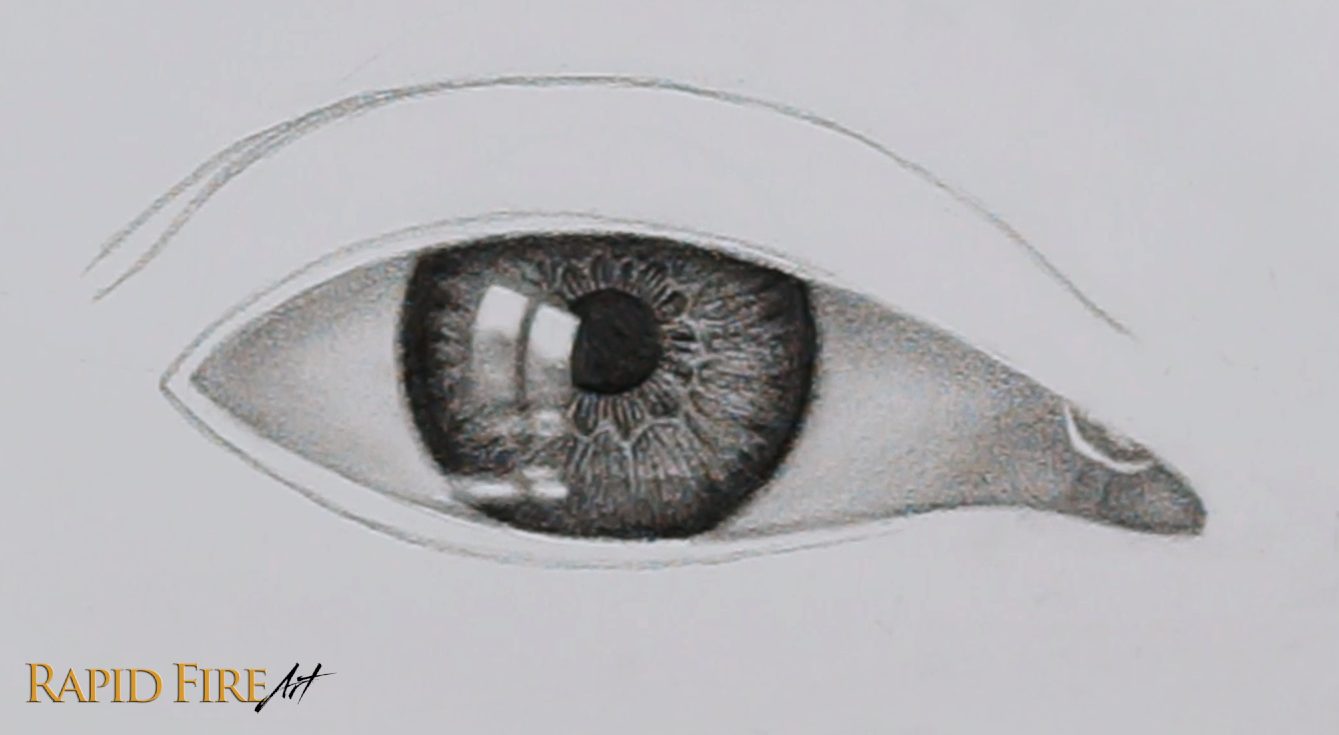
Make sure the rest of your eyeball is shaded in. We want the lightest areas of this entire drawing to be our highlights.

Shade the far left and far right of your eyeball gradually darker using an HB pencil. Then blend with a tissue.

How to Draw a Teary Crying Eye Step 7_2

Shade along the very top of the eyeball to make it look like the eyelid is casting a shadow. Shade lightly along the bottom of your eyeball as well to make it look curved.

Shade the inner corner of the eye pretty dark to convey depth, especially around the edges. Draw some lines/curves in this space and blend them well so they look like bumps and folds.

Step 8: Shade the Skin Around the Eyes

How to Draw a Teary Crying Eye Step 8_1

Note: This shading instruction is different from the video tutorial to keep things simple.

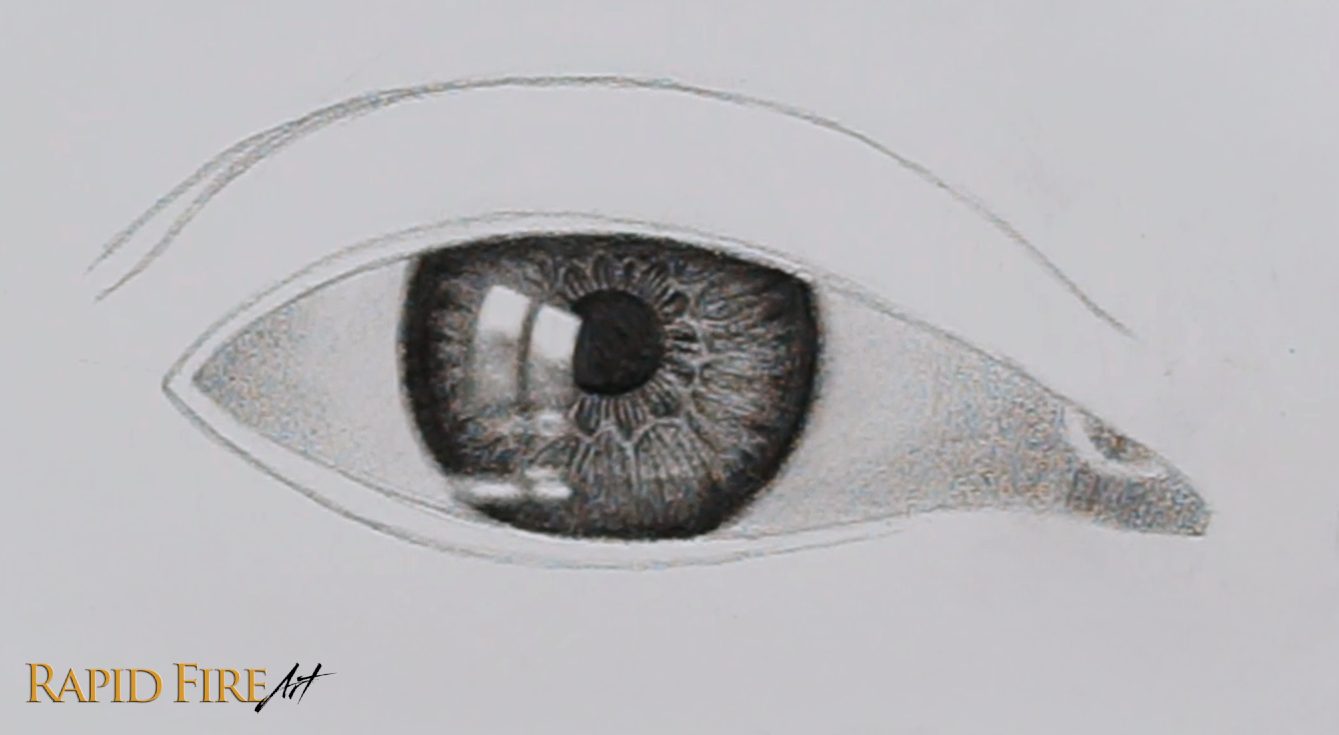
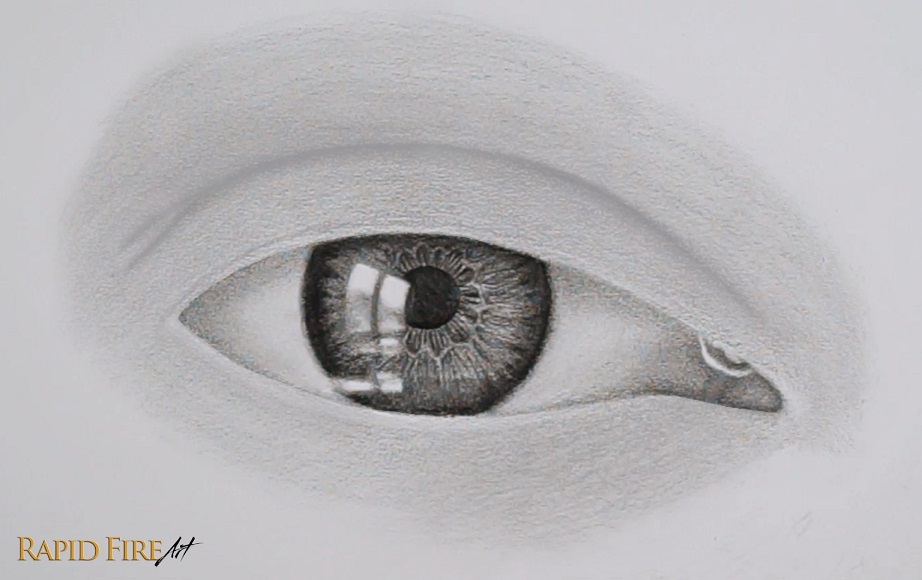
Using your 4B pencil, shade a light and even layer of graphite across all areas of skin around the eyes. Blend it well using a tissue wrapped around the padded part of your finger. Switch to a clean spot on your tissue often to prevent blotches. Be careful not to smudge the details inside the eye.

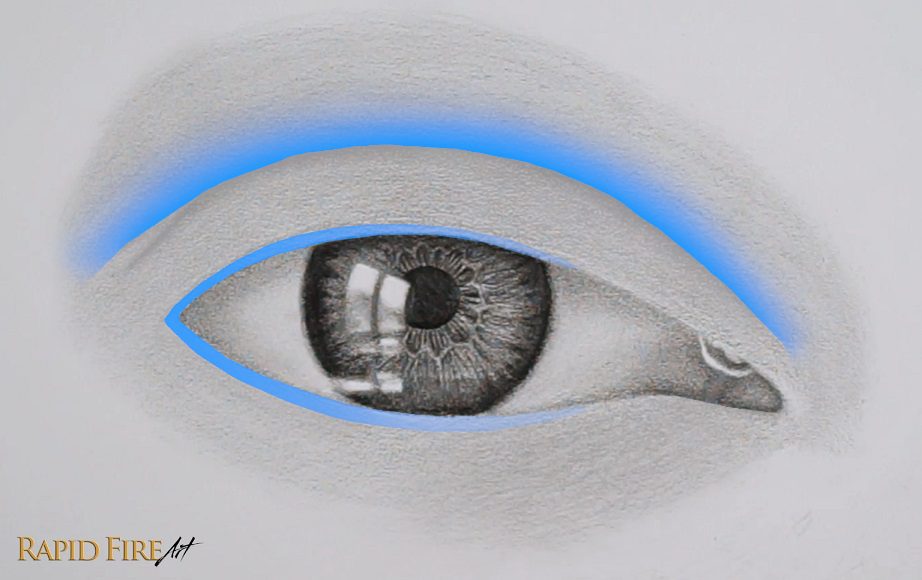
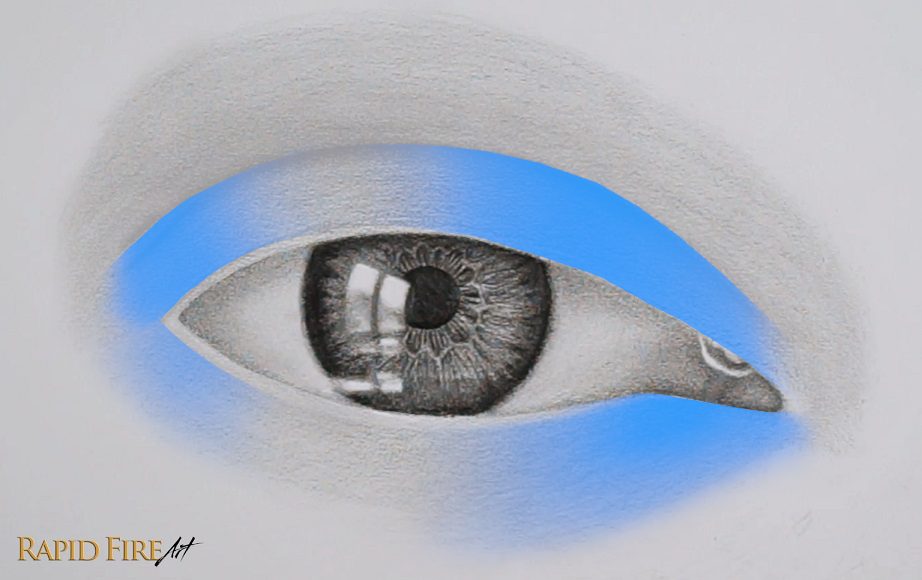
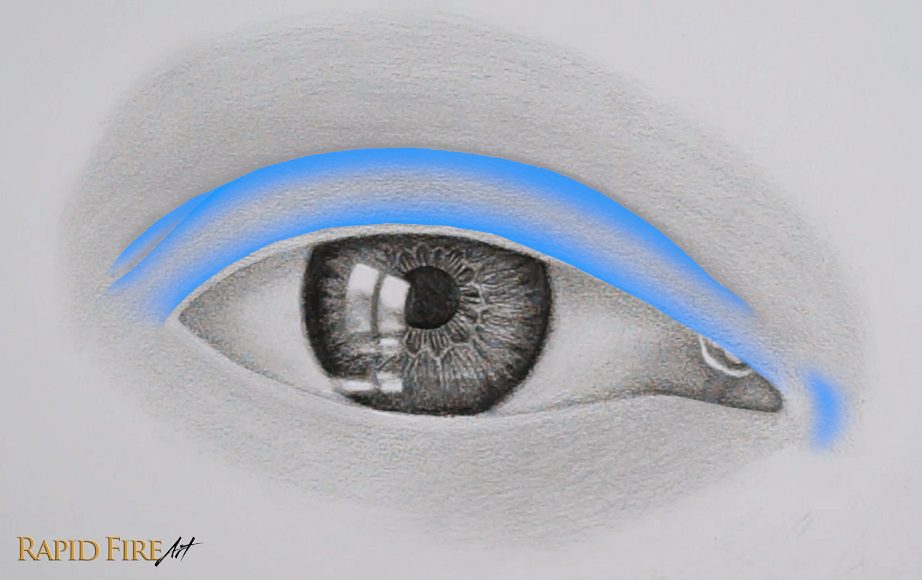
Then, for all the areas highlighted in blue below, shade darker to make the skin appear curved. Lighten your strokes gradually as you approach areas where the skin should be lighter. Shade the eyelid crease the darkest.

My imaginary light source comes from the top left, making the right side of the eye a little darker than the left side.

Where to Shade Eyes_1
Where to Shade Eyes_2
Where to Shade Eyes_3

Step 9:  Tweaks and Optional Details to Make Your Eye Drawing More Realistic

How to Draw a Teary Crying Eye Step 9

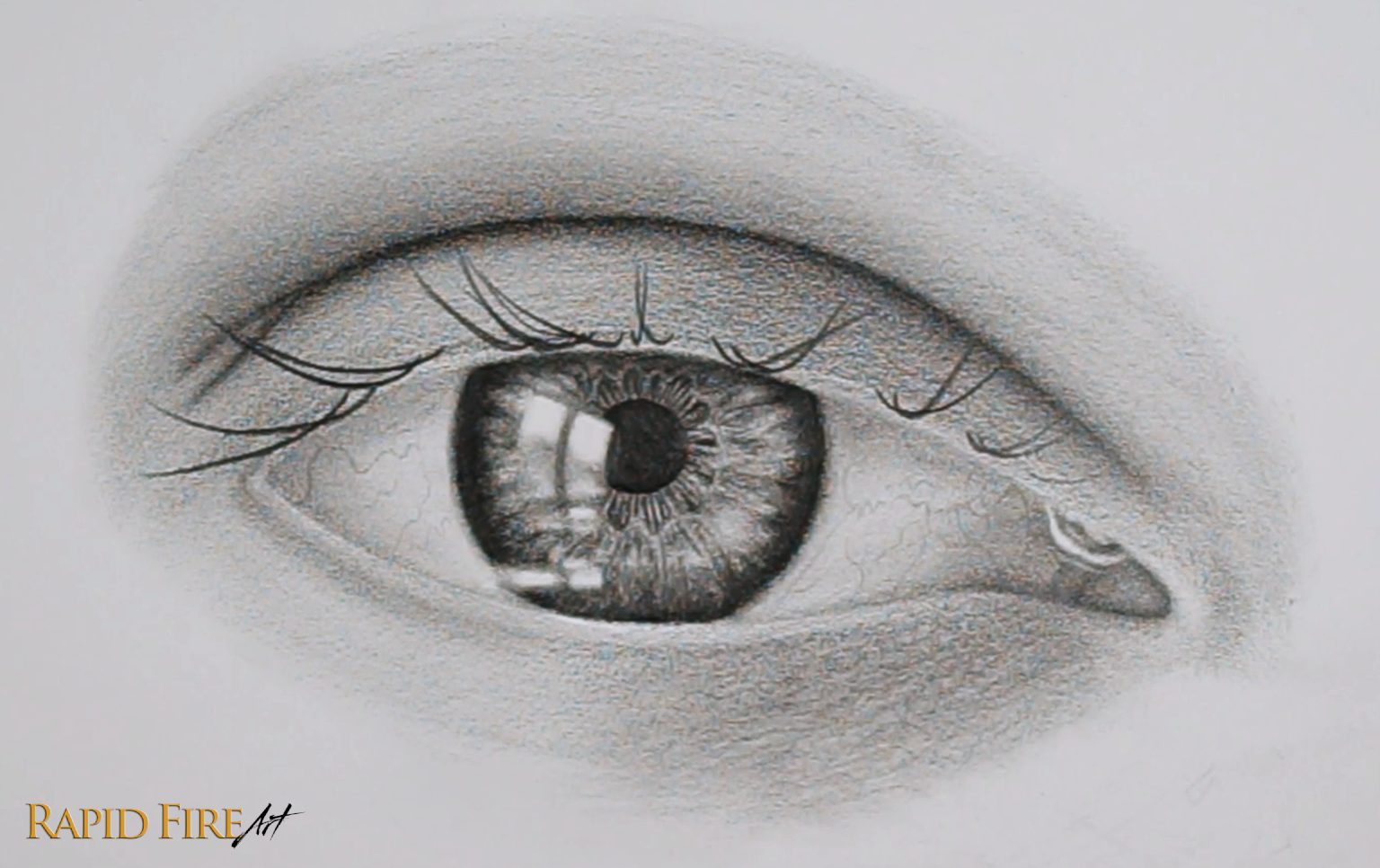
Before we draw the eyelashes, it’s a good idea to look over your entire drawing to see if you’d like to fix anything as well as try to make your shading smoother. Keep in mind that after you’ve drawn the eyelashes, it will be more difficult to blend the skin because you will need to blend around each lash, or risk smudging them.

If you look closely, you can see I’ve added some subtle squiggly blood vessels along the eyeball using my 2H pencil. This is a totally optional detail to help make the eye more realistic! If you darken the blood vessels, it can help make the eye look more sad, since our eyes do become more red when we cry.

Inside the iris, I used my eraser to lighten more spokes at random. I also added large bright patches using my kneaded eraser rounded to a blunt tip and dragged lightly in the same direction the spokes are pointing.

I also added 3 new subtle highlights surrounding the one at the inner corner of the eye. If you like how yours looks currently, feel free to keep it that way!

Step 10: How to Draw Eyelashes

How to Draw a Teary Crying Eye Step 10_1

For my eyelashes, I’m using a 2B pencil. Test your pencils to see which one you prefer. I chose the 2B because it stays sharp for a long time, giving me clean strokes, and the value is dark enough for my preference.

Eyelash Angles J Shape Examples

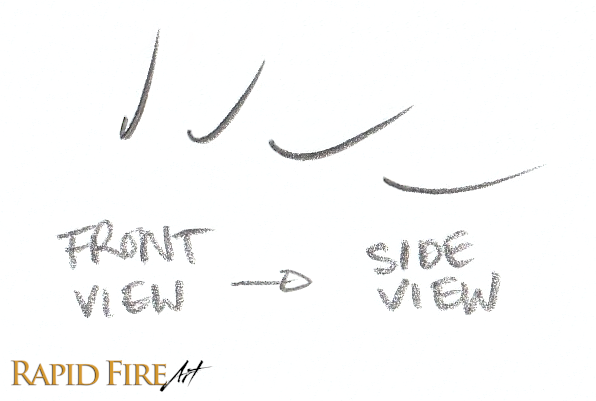
Draw your eyelashes along the eyelid’s ledge. If you struggle with drawing eyelashes, just think of them as “J” shapes. Vary your “J” shapes from narrow to wide and from deep to shallow.

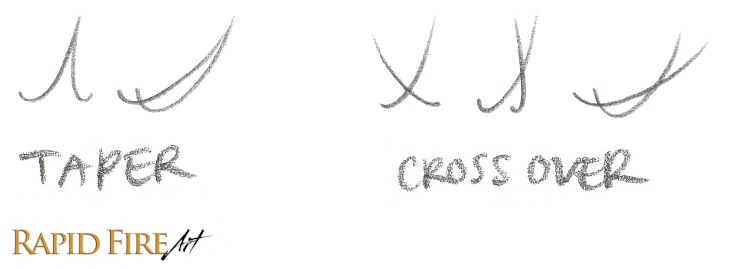
Taper and Crossover Eyelash Examples

To make your lashes look realistic and natural, try to avoid any repetitive patterns. You can do that by varying the length, the angle, making them cross over each other, or taper them together at the ends for example.

How to Draw a Teary Crying Eye Step 10_2

Make sure your lashes are shorter, thinner and lighter the closer they are to the inner corner of the eye.

How to Draw a Teary Crying Eye Step 10_3

Layer on more and more eyelashes until you are satisfied.

How to Draw a Teary Crying Eye Step 10_4

Do the same for your lower lashes. You might find that spreading your lashes out and jumping back and forth randomly will help you to draw more natural-looking lashes as opposed to drawing them all in order from one side to the other.

How to Draw a Teary Crying Eye Step 10_5

I like to keep my lower lashes more sparse. If you are planning to draw lots of teardrops, you can taper many lashes together because hair likes to stick together when wet.

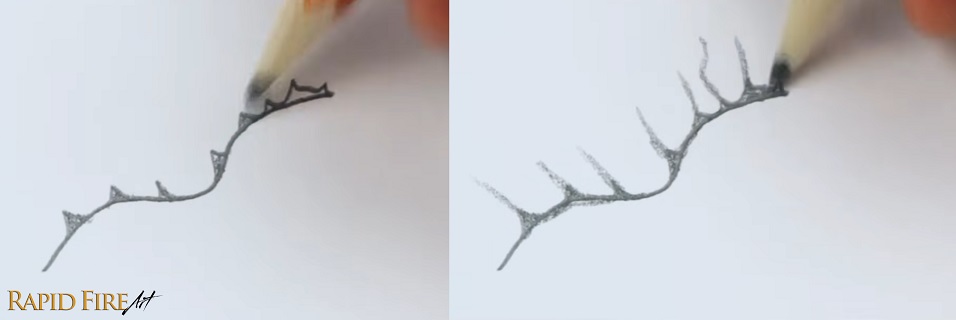
Give your eyelashes some shadows and add texture to the skin around the base of each hair. This subtle detail can be acheived by lightly drawing circular/loopy patterns along the top and bottom eyelid ledges where the eyelash roots are. Make your circles lighter and more subtle where the lashes are few and far between.

Step 11: Tweak Your Eye Drawing

Take a few steps away from your drawing, or better yet, take a long break to reset your brain. Now look at your entire drawing to see if you want to darken, lighten, add, or fix anything.

How to Draw a Teary Crying Eye Step 11

I decided to add some more lashes to the top eyelid and make some of them longer. I also darkened the eyelid crease to increase the contrast, as well as darken the eyelid cast shadow along the entire eyeball. Do whatever you feel like to make the eye most appealing to you.

Step 12: How to Draw A Realistic Teardrop on Your Sad Eye

How to Draw a Teary Crying Eye Step 12_1

First pick where you’d like the teardrop to fall. Ideally an area in between lashes. Make sure the skin in your chosen area is shaded and blended well. This is to make sure the teardrop shows up well. Keep in mind that the lighter the skin, the less prominent the teardrop will appear because a lack of contrast.

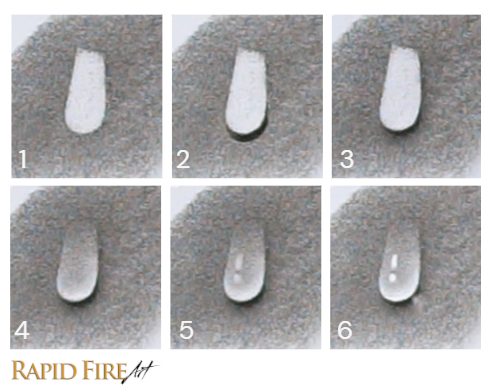
How to Draw a Teardrop Progression
  1. Now erase a teardrop shape. Make the bottom of your teardrop as round as you can.
  2. Consider where the main light source in your drawing is coming from. In this example, it’s coming from the top left, so we’ll draw a shadow on the bottom right, below our teardrop.
  3. When you blend, make your shadow fade out gradually the further it is from the teardrop. I used a tissue to achieve a soft fade. As you shade and blend, try to keep the edges of your teardrop clean and crisp!
  4. Identify the area that will be illuminated inside your teardrop. This area will be right against the cast shadow you just drew. Shade inside your teardrop while avoiding the illuminated zone. You’ll want to shade darkest at the very top of the teardrop and lighter gradually as you move downward. Only shade as dark as the surrounding skin. Blend while making sure the top of our teardrop is blended extra well. Our goal is to make the top of the teardrop blend in with the skin tone to make it look as though the tear is dripping down.
  5. Next, use your eraser to create mini highlights that loosely match your Main Highlights. Since the teardrop is small, you can simplify the shape as much as you need. If the shapes are ambiguous, they may look like blobs.
  6. Optional: You can use a white gel pen to boost the lightest parts of your teardrop. You can also erase a little wedge shape in the cast shadow under the tear to convey light exiting the teardrop.
How to Draw a Teary Crying Eye Step 12_2

An optional detail to make the bottom eyelid look more watery is to erase blob-shaped highlights around/above your teardrop.

Now take a step back from your drawing to see it as a whole. Do you want to tweak anything? If you want your eye to pop more, try making the dark areas darker and the light ones even lighter. You can only erase so much, so try using some correction fluid or a white gel pen to really make those highlights really pop!

A Few Last Notes

This tutorial has been more than a year in the making, partly because editing a 10-hour raw recording into something watchable takes a surprising amount of time and energy haha. I wanted this written version to simplify the process even further, giving you enough steps without overwhelm.

But I’m still learning how to balance depth and simplicity, so your feedback would be amazing. If you watched the Teary Eye Youtube video, did this written version support you? Does it make things easier to understand? Your insight will help me improve future tutorials here on my blog so I can support you in the best way possible.

Thank you!

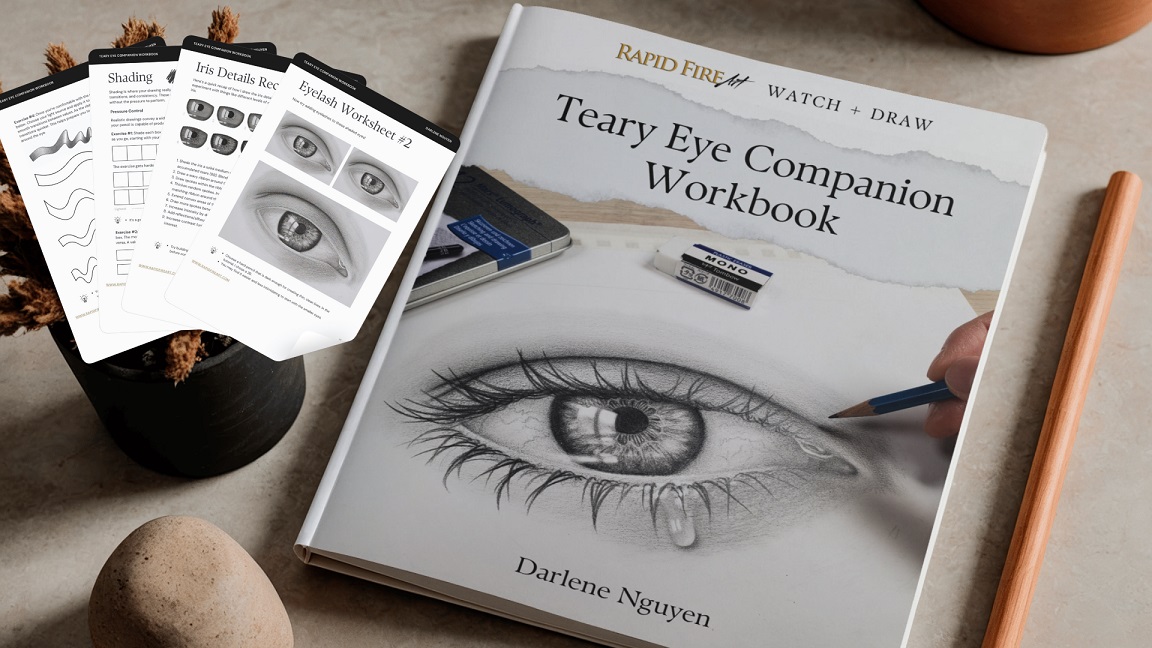
If you want more guided practice, I’ve made a companion workbook (ebook) which includes: printable pages of this exact eye that you can practice on, shading exercises, eyelash exercises, and more to help you build confidence and improve your technique. Click here to learn more!

Happy drawing!

Darlene

How to Draw a Teary Eye in 12 Steps Read More »
Scroll to Top